

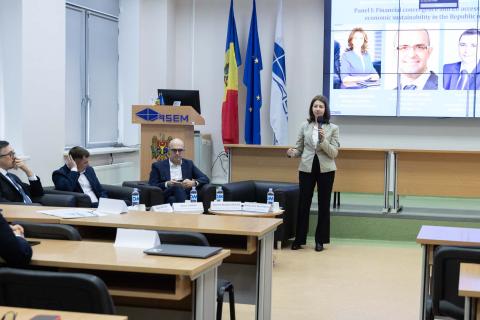



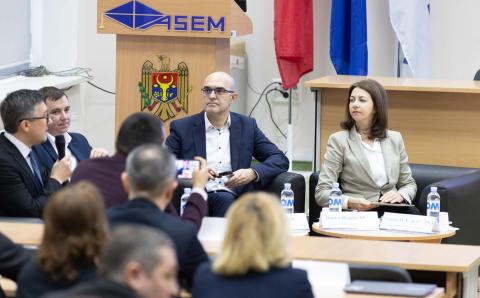
Today, 27 November 2025, Deputy Governor of the National Bank of Moldova, Tatiana Ivanicichina, participated in the conference "Modern Finance from the Perspective of Sustainability of National Economies," organised by the Academy of Economic Studies of Moldova (ASEM).
During the panel discussion "Financial convergence and EU accession – pillars of economic sustainability in the Republic of Moldova," the Deputy Governor of the NBM highlighted the role of transformations in the financial sector in the European integration process and their impact on macroeconomic stability and investor confidence.
"Harmonisation with European Union standards goes beyond the technical framework of legislation. It is a strategic investment in the modernisation of the Republic of Moldova and the strengthening of its institutions. Through a solid and transparent financial system, we support the ambitions of a European economy and create the conditions for increasing the well-being of every citizen," said the Deputy Governor.
Tatiana Ivanicichina also presented the concrete results achieved in the area of European financial integration. The Deputy Governor spoke about macroeconomic stability, with falling inflation and the security of the banking sector, where the capital adequacy ratio reached 25.6%, above the minimum prudential level. The modernisation of the payment infrastructure is reflected in the MIA Instant Payments system, already used by over 800,000 citizens, with over 12.5 million transactions processed this year. Another major step forward is Moldova's accession to SEPA, which generated direct savings of €1.4 million in the first month after its launch.
As for priorities for 2026, the National Bank of Moldova will transpose into national law the regulations set out in the EU acts relating to the CRD VI/CRR III package, which also ensures equivalence with Basel III standards. These EU regulations cover various areas of banking activity that contribute to strengthening the stability and resilience of the banking sector by establishing appropriate capital requirements and regulating various risks, as well as corporate governance requirements.
The event brought together officials from key state institutions, leading banking sector specialists, academics, and international experts.