
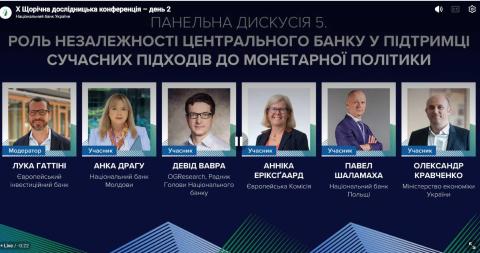
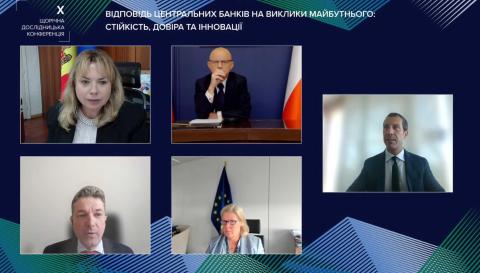
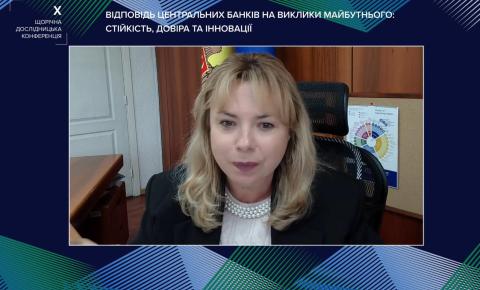
The Governor of the National Bank of Moldova (NBM), Ms Anca Dragu, participated in the tenth Annual Research Conference, jointly organised by the National Bank of Ukraine and the National Bank of Poland on 21–22 September 2026 in Kyiv, held online.
This year’s edition, held under the theme “Central Banks’ Response to Future Challenges: Resilience, Credibility and Innovation”, brought together representatives of central banks, European institutions and international financial organisations, as well as economic researchers and experts.
During the panel discussion “Role of Central Bank Independence in Supporting Modern Monetary Policy Frameworks”, Governor Anca Dragu joined representatives of the National Bank of Poland, the National Bank of Ukraine and the European Commission to discuss the importance of institutional independence in maintaining price stability and strengthening public confidence.
“Independence, accountability and transparent communication reinforce one another and strengthen the central bank’s mandate. Central bank independence is a fundamental condition for fulfilling its mandate. It must be accompanied by accountability and active public communication. A credible central bank exercises its mandate with professionalism, transparency and consistency, while always taking into account the interests of the population and the sound functioning of the economy,” said NBM Governor.
Referring to the experience of the Republic of Moldova, Ms Anca Dragu noted that the NBM has carried out its mandate against the backdrop of successive and overlapping crises: the pandemic, Russia’s war against Ukraine, the energy crisis and external inflationary pressures. For a small economy exposed to external shocks and imported inflation, clarity of objectives, independent decision-making and consistent communication are crucial to maintaining macroeconomic stability.
The NBM Governor also highlighted the resilience of the banking sector in the Republic of Moldova, which remains stable, liquid and well-capitalised. Reforms implemented in recent years, alignment with European standards and the strengthening of the supervisory framework have contributed to greater confidence among investors and international partners.
Another topic addressed was European integration, presented as a strategic direction for modernising and strengthening the financial system. The results of the Republic of Moldova’s accession to the Single Euro Payments Area (SEPA) already demonstrate the tangible impact of this process: between October 2025 and August 2026, approximately 1.1 million transfers were processed, while the savings generated for individuals and companies are estimated at nearly EUR 15 million. The average cost of a transfer fell from at least EUR 20 to approximately EUR 1, making it around 14 times lower than through the channels previously used. At the same time, the MIA instant payments system has attracted more than 1 million users and processed over 31 million transactions, with a total value of MDL 28.5 billion. These results show that closer integration with the European Union is already translating into faster, more accessible and more efficient financial services for individuals and businesses.
In conclusion, Ms Anca Dragu stressed that independence does not mean isolation. Cooperation with national authorities, central banks and European institutions is indispensable; however, monetary policy decisions must be taken autonomously, based on data, professional analysis and the mandate established by law.
The annual conference organised by the central banks of Ukraine and Poland provides an international platform for dialogue and research on current challenges facing monetary policy, financial stability and the technological transformation of central banks.