
The financial situation of the banking sector remains solid, reflecting the constant efforts of the National Bank of Moldova (NBM) to strengthen stability and increase confidence in the banking sector.
Throughout 2025, according to data provided by the banks, the banking sector is characterised by growth in assets, loans, own funds, deposits of individuals, and deposits of legal entities. At the same time, banks have complied with prudential requirements, maintaining key indicators at appropriate levels and demonstrating a good capacity for adaptation and capital strengthening.
As of 31 December 2025, ten licensed banks were operating in the Republic of Moldova, following the completion of the reorganisation process through the merger of B.C. "VICTORIABANK" S.A. and Banca Comercială Română Chișinău S.A. (BCR Chișinău S.A.). As a result of this merger, the license of BCR Chișinău S.A. was withdrawn in accordance with the Decision No 71 of 13 March 2025 of the Executive Board of the National Bank of Moldova.
At the same time, the National Bank of Moldova continued to promote important reforms in the field of banking regulation and legislative harmonisation, in line with European Union standards and Basel III requirements, contributing to the modernisation of the financial system and the advancement of the European integration process.
Financial situation of the banking sector and compliance with prudential regulations
As of 31 December 2025, the situation in the banking sector, as reflected in the reports submitted by the banks, showed the following trends:
Assets and liabilities
Total assets amounted to MDL 190,055.1 million, increasing by 11.6% (MDL 19,698.8 million) during 2025..
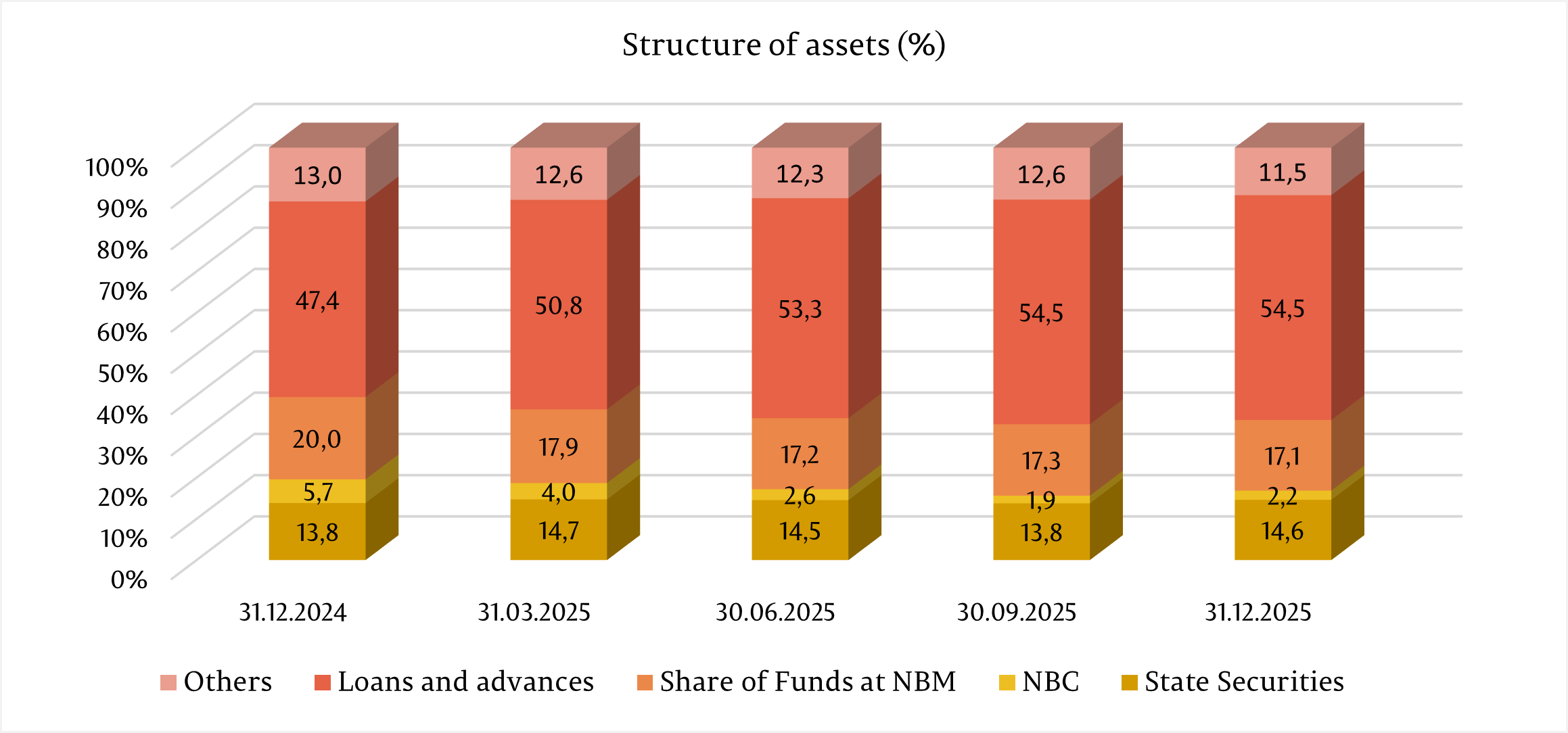
In the asset structure, the largest share was held by loans and advances at amortised cost, which amounted to 54.5% (MDL 103,604.6 million), increasing by 7.1 percentage points (p.p.) compared to the end of the previous year. The share of funds placed with the NBM amounted to 17.1% (MDL 32,557.6 million), decreasing by 2.9 p.p., while the share of banks' investments in state securities and NBM certificates accounted for 16.8% (MDL 32,015.4 million), down by 2.7 p.p. The remaining assets, which account for 11.5% (MDL 21,877.5 million), are held in other banks in cash, tangible assets, intangible assets, etc. Their share decreased by 1.5 p.p. compared to the end of 2024.
 [1]
[1]
The gross (prudential) balance of loans accounted for 54.9% of total assets, or MDL 104,251.2 million, increasing by 29.0% (MDL 23,426.6 million) during the period under review.
The largest increase was recorded in loans granted for the purchase/construction of real estate, by MDL 7,485.6 million (40.2%), up to MDL 26,092.6 million, in consumer loans – by MDL 4,480.9 million (30.4%), to MDL 19,241.7 million, in loans granted to trade – by MDL 4,322.0 million (25.7%), to MDL 21,156.3 million, in other loans granted – by MDL 1,837.3 million (81.8%), up to MDL 4,082.2 million, and loans granted to services sector – by MDL 1,117.5 million (39.1%), up to MDL 3,974.3 million.
At the same time, during 2025, the largest decrease was recorded in loans granted to administrative-territorial units/institutions subordinated to administrative-territorial units, by MDL 204.8 million (18.7%), to MDL 890.8 million.
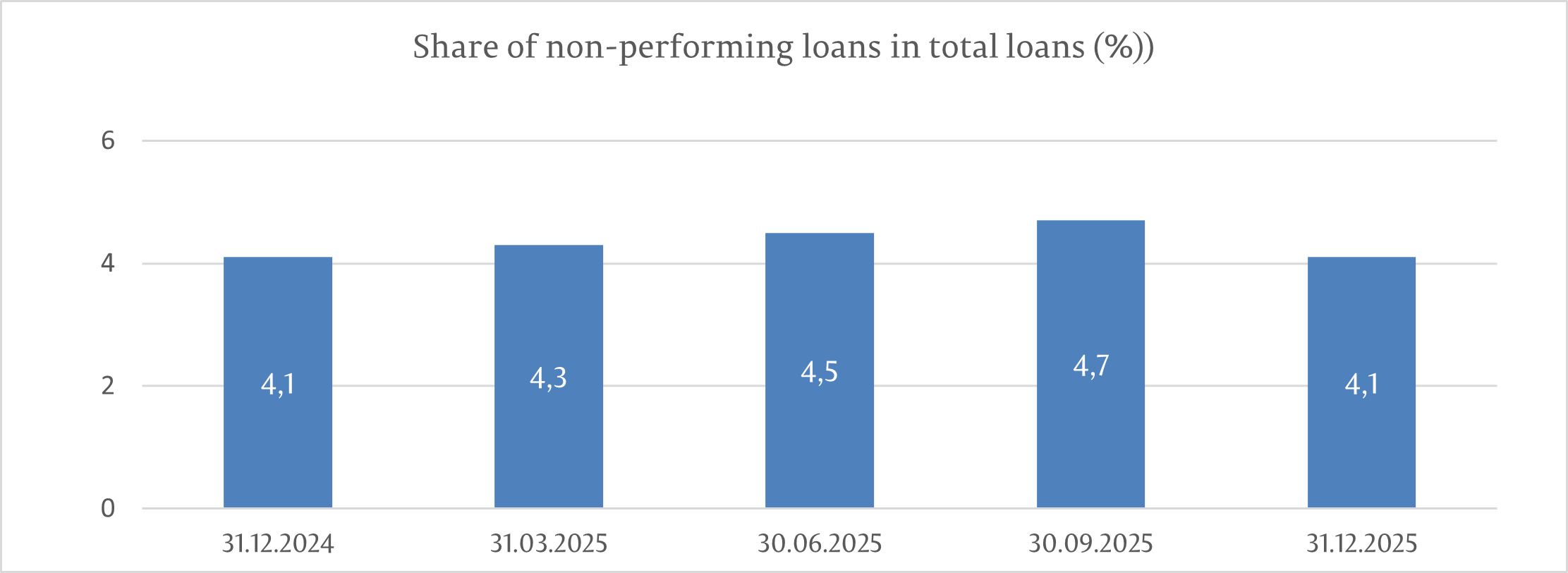
The share of non-performing loans in total loans (prudential) as of 31 December 2025, was 4.1%, unchanged from the end of the previous year, but remaining at historically low levels. At the same time, during the period under review, the share of expired loans in total loans decreased by 0.5 p.p., accounting for 1.4%.
 [2]
[2]
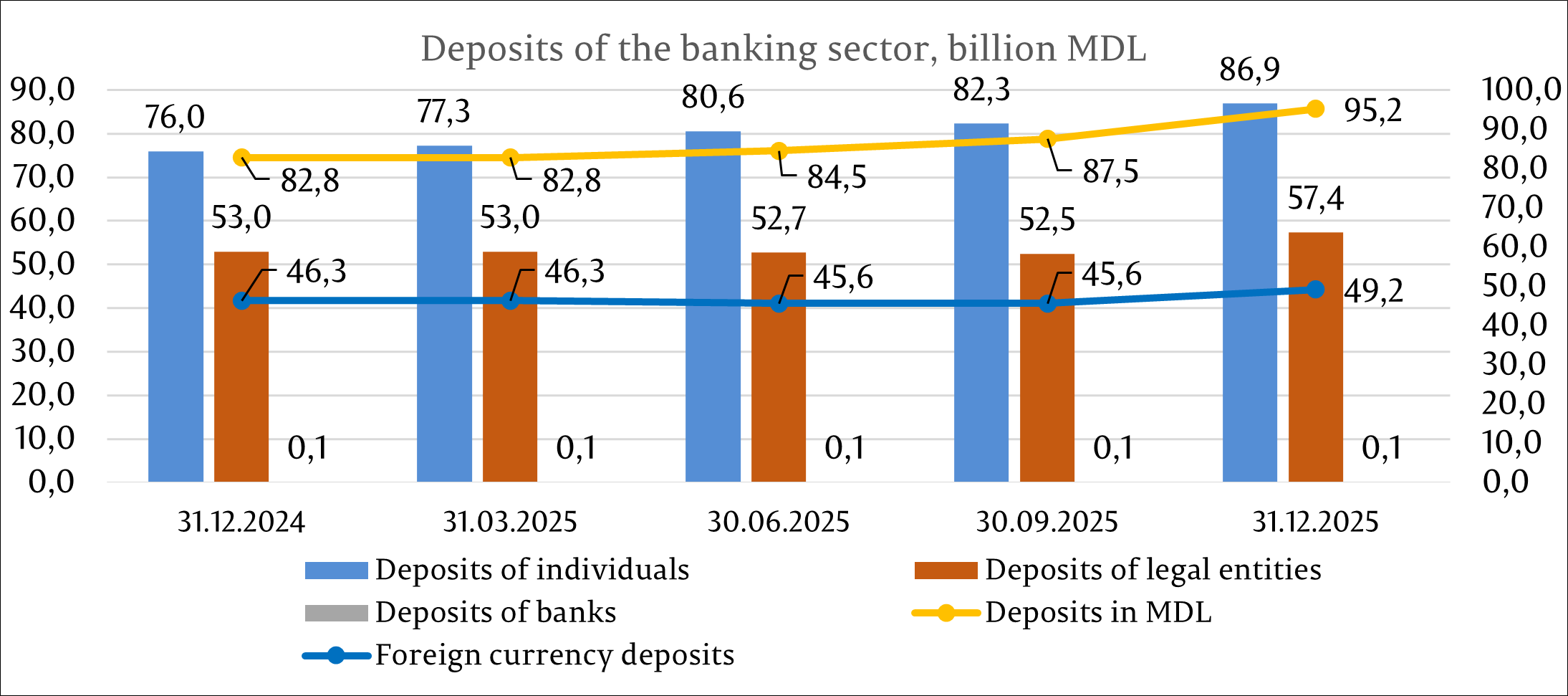
The total balance of deposits increased by MDL 15,331.0 million or 11.9% compared to the end of the previous year, amounting to MDL 144,422.8 million (deposits of individuals accounted for 60.1% of total deposits, deposits of legal entities – 39.8%, and deposits of banks – 0.1%), as a result of an increase in the balance of deposits of individuals by MDL 10,909.3 million (14.4%) to MDL 86,867.7 million and in the balance of legal entities’ deposits by MDL 4,426.5 million (8.3%) to MDL 57,438.5 million.
Of the total deposits, 65.9% were deposits in MDL, their balance increasing by MDL 12,474.3 million (15.1%) compared to the end of the previous year and amounting to MDL 95,242.1 million as of 31 December 2025. Accordingly, foreign currency deposits accounted for 34.1% of total deposits, their balance also increasing during the year by MDL 2,856.7 million (6.2%), amounting to MDL 49,180.7 million.
 [3]
[3]
Revenues and profitability
As of 31 December 2025, according to data provided by banks, the banking sector's profit amounted to MDL 4,925.7 million, increasing by MDL 937.8 million (23.5%) compared to the end of the previous year, mainly due to the increase in interest income by MDL 2,249.5 million (25.2%) to MDL 11,161.3 million, as a result of the increase in income from lending activities by MDL 1,621.4 million (24.3%) to MDL 8,284.8 million.
Return on assets stood at 2.7%, and return on equity was 16.9%, both indicators increasing compared to the end of the previous year, by 0.3 p.p. and 2.2 p.p., respectively. Profitability indicators point to a stable and efficient banking sector with solid profitability and good resource utilisation capacity.
Compliance with prudential requirements
Throughout 2025, banks maintained liquidity indicators at a high level, above the regulated limits. Accordingly, prudential liquidity indicators are complied with by all banks.
The net stable funding ratio (NSFR), which represents the ratio between the bank's available stable funding and the required stable funding, was 170.2% as of 31 December 2025 (limit ≥ 100%) (in force since 30 September 2025). This indicator ranged from 151.3% to 341.5%.
The long-term liquidity ratio (Liquidity Principle I) was 0.80 (limit ≤1), ranging from 0.61 to 0.91, depending on the bank.
Liquidity Principle III, which represents the ratio between adjusted actual liquidity and required liquidity for each maturity band and which must not be less than 1 for each maturity band, ranged from 1.15 on the maturity band up to and including one month to 64.58 on the maturity band between six months and twelve months inclusive.
The liquidity coverage ratio (LCR) by sector was 295.0% (limit ≥ 100%), ranging from 192.7% to 937.2%, depending on the bank.
According to reports submitted by banks as of 31 December 2025, the total own funds ratio for the banking sector stood at 23.3%, down 3.0 p.p. from the end of the previous year, as a result of the increase in total risk exposure by MDL 15,685.7 million (18.4%) (increase in the loan portfolio). This indicator ranged between 19.9% and 39.6%, depending on the bank. All banks complied with the "Total own funds ratio" indicator (limit ≥ 10%).
Banks also complied with the requirement for the "Total own funds ratio" indicator, taking into account capital buffers.
As of 31 December 2025, total own funds amounted to MDL 23,573.6 million, up 4.9% (MDL 1,106.2 million). The increase in own funds was determined by the reflection by some banks of eligible profits after the general meetings of shareholders and after obtaining the permission of the NBM to include the profits obtained in own funds. At the same time, seven banks distributed dividends in accordance with the decisions of the shareholders.
As of 31 December 2025, the banks complied with prudential indicators on large exposures and exposures to their related persons.
During the reporting period, all banks complied with the limit of the dominant position in the banking market, remaining below the 35% limit for this indicator in terms of assets and deposits of individuals, with the exception of one bank, which exceeded the 35% dominant position limit in terms of assets, reaching 35.7%, and the dominant position in the banking market in terms of deposits of individuals stood at 36.0%.
Development of the national legal framework and its harmonisation with EU legislation
During 2025, the National Bank of Moldova developed and updated secondary normative acts for the implementation of Law No 202/2017 on the activity of banks, promotion of Basel III requirements and best practices in the field.
Thus, by Decision No 3 of 9 January 2025, amending Regulation No 110/2018 on capital buffers of banks (effective as of 16 February 2025), the secondary regulatory framework for own funds that banks are required to hold in order to build up capital buffers was updated. The amendments ensured alignment with the amendments introduced by EU Directive No 36/2013 on access to the activity of credit institutions and the prudential supervision of credit institutions by EU Directive 2019/878.
The amendments provide for an increase from 2% to 3% in the O-SII buffer cap for systemically important companies, which may be set by the National Bank of Moldova.
Additionally, the amendments supplement the secondary framework with provisions on the use of core tier 1 own funds that are maintained to meet the combined buffer requirement in relation to the own funds requirements set for the risk associated with excessive use of leverage.
At the same time, by Decision No 176/2025 of the Executive Board of the National Bank of Moldova, the new Regulation on the leverage was approved, transposing the provisions of Part Seven of Regulation (EU) 575/2013, as amended by Regulation (EU) 2024/1623. Simultaneously, point 130 of Regulation No 109/2018 on own funds of banks and capital requirements was supplemented with the requirement for a leverage ratio of 3%. Regulation No 158/2020 on the requirements for publication of information by banks has been amended so that, starting 1 January 2026, banks will have to disclose information on the leverage ratio and its components. The provisions of Regulation No 322/2018 on banking activity management framework have also been amended in line with the new Leverage Regulation.
By Decision No 177/2025 of the Executive Board of the National Bank of Moldova, amendments were made to Regulation No 109/2019 on large exposures, which aimed to supplement the regulation with specific provisions for determining indirect exposures to a client arising from derivative contracts, by transposing Delegated Regulation (EU) 2022/1011 supplementing Regulation (EU) No 575/2013 with regard to regulatory technical standards specifying how to determine indirect exposures to a client arising from derivatives and credit derivatives contracts where the contract was not directly entered into with the client, but the underlying debt or equity instrument was issued by that client.
During the reporting period, by Decision No 218/2025of the Executive Board of the National Bank of Moldova, amendments were made to Regulation No 292/2018 on requirements regarding the members of the governing body of the bank, the financial holding company or mixed holding, the heads of a branch of a bank from another state, the persons holding key positions and the liquidator of the bank in liquidation process. Thus, the regulation has been supplemented with provisions related to streamlining the process of assessing/reassessing members of the governing body of banks, the heads of branches of banks in other countries, and persons in key positions, and optimising the process of monitoring persons for their compliance with the criteria established by the normative framework. At the same time, the amendments aim to improve corporate governance in the private sector by specifying, clarifying, and streamlining certain aspects, namely improving the mechanism for assessing/reassessing persons nominated for management positions and persons holding key functions.
Furthermore, by Decision No 219/2025 of the Executive Board of the National Bank of Moldova, Regulation No 322/2018 on banking activity management framework was supplemented with provisions aimed at updating, improving, and strengthening corporate governance in banks by aligning it with the international normative framework in this area, including the rules prescribed within the EU. The main changes include provisions related to the development of elements that need to be taken into account when assessing whether members of the governing body allocate sufficient time to perform their duties; compliance with gender neutrality in the development and implementation of remuneration policy; policies on conflicts of interest of employees resulting from previous relationships; supplementing the policy on the appointment of members of the governing body and persons holding key functions with a succession plan, a policy to promote diversity within the governing body, and a policy for the induction and training of members of the governing body and persons holding key functions, etc.
By Decision No 220/2025 of the Executive Board of the National Bank of Moldova, the Regulation on the treatment of counterparty credit risk for banks was approved, which aims to introduce new treatment related to risk management regulation, namely with regard to the treatment applicable to counterparty credit risk, in particular by introducing own funds requirements and new methods for determining the exposure value for bilateral contracts with derivative financial instruments, repurchase transactions, securities or commodities lending or borrowing transactions, long settlement transactions, and margin lending transactions.
In the context of the National Bank of Moldova's commitment to align the Republic of Moldova's banking legislation with the European Union acquis, by Decision No 221/2025 of the Executive Board of the National Bank of Moldova, the Regulation on the prudential treatment of securitisation was approved, which represents the secondary normative framework for the prudential treatment of securitisations.
The approval of the Regulation on the leverage necessitated the amendment and supplementation of the Instruction on the submission of COREP reports by banks for the purpose of supervision (approved by Decision No 117/2018 of the Executive Board of the National Bank of Moldova). Thus, the NBM Decision No 252/2025 on amending the Instruction on the submission of COREP reports by banks for the purpose of supervision and the Regulation on the leverage (on leverage reporting) aims to amend Annex No 102, on the basis of which the NBM monitored the leverage ratio of banks and approved the new form for reporting information on the leverage ratio.
The need to approve the new normative framework for own funds requirements for operational risk stems from changes made to the European normative framework, which replaced multiple approaches (basic approach, standardised approach, and advanced measurement approach) with a single one—the new standardised approach. Thus, by Decision No 311/2025 of the Executive Board of the National Bank of Moldova, the Regulation on the treatment of banks’ operational risk for according to the basic approach and the standardised approach (approved by Decision No 113/2018 of the Executive Board of the National Bank of Moldova) was repealed and approved the Regulation on own funds requirements for operational risk, which aims to establish the formula for calculating own funds requirements for operational risk, establish the need to calculate annual losses from operational risk, and require banks to have an operational risk management framework in place. The provisions of the Regulation on banking activity management framework (approved by Decision No 322/2018 of the Executive Board of the National Bank of Moldova) and the Regulation on the requirements for publication of information by banks (approved by Decision No 158/2020 of the Executive Board of the National Bank of Moldova) with the provisions of the new regulatory framework for own funds requirements for operational risk.
At the same time, during 2025, the National Bank of Moldova continued the process of harmonising the Republic of Moldova's legal framework in the field of foreign exchange with European Union legislation covering Chapter 4 - Free Movement of Capital.
In this context and with a view to implementing the National Action Plan for the accession of the Republic of Moldova's to the European Union 2024–2027 (approved by Government Decision No 829/2023), the draft law prepared by the NBM to amend Law No 62/2008 on foreign exchange regulation was adopted by Parliament through Law No 124/2025, which entered into force on 12 July 2025.
Accordingly, by Decision No 253/2025 of the Executive Board of the National Bank of Moldova, amendments were approved to Regulation No 165/2019 on certain aspects related to export and import of cash and traveller’s cheques by banks, which repealed the provisions relating to the issuance by the National Bank of Moldova of authorisations to banks for the export from/import into the Republic of Moldova of cash in the national currency, the obligation to present the authorisation of the National Bank of Moldova to the customs authorities, as well as other provisions related to the authorisation procedure for the operations in question.
By Decision No 254/2025 of the Executive Board of the National Bank of Moldova, the Instruction on reporting to the National Bank of Moldova by foreign exchange offices and hotels (effective from 1 January 2026) was approved, the purpose of this Instruction was to optimise the normative framework for reporting to the National Bank of Moldova on daily exchange rates and monthly foreign exchange operations carried out by foreign exchange offices and hotels and to facilitate the application of these norms by them. In addition, the norms regarding the consistency of foreign exchange rates reported by foreign exchange offices and hotels have been adjusted, and certain aspects related to reporting on foreign exchange rates have been clarified, taking into account the frequency of their change. Simultaneously with the approval of the new instruction, two normative acts relating to the submission of reports by foreign exchange offices and hotels to the National Bank of Moldova were repealed.
The Decision No 255/2025 of the Executive Board of the introduced amendments to Regulation No 14/2009 on the issuance by the National Bank of Moldova of authorisations to export funds from the Republic of Moldova, Regulation No 51/ 2009 on authorisation of certain foreign exchange operations by the National Bank of Moldova, Regulation No 216/2015 on residents’ accounts abroad, Regulation No 304/2016 on licensing of foreign exchange entities, and Regulation No 335/2016 on the activity of foreign exchange entities. The amendments in question refer to the exclusion of the requirement for applicants for authorisations to submit identification/identity documents to the National Bank of Moldova, the completion of the conditions for authorisation, the specification of the grounds for refusal of authorisation in the context of the application of international restrictive measures on the territory of the Republic of Moldova (when opening an account with a non-resident bank), and specifying the norms governing the suspension/resumption/termination of foreign exchange activities in the context of unforeseen events (such as technical malfunctions of the video surveillance and recording system for foreign exchange activities).
Through these initiatives, the National Bank of Moldova contributes to the modernisation of the national financial system and the advancement process of the Republic of Moldova's accession to the European Union. Thus, constant efforts towards legislative harmonisation strengthen the transparency, stability, and resilience of the banking sector, benefiting the economy and citizens.