Welcome to the official website of the National Bank of Moldova!
×
Do you have good eyesight and want to turn this tool off?



Welcome to the official website of the National Bank of Moldova!
You can choose one of the most popular reports from the list:

National Bank and the members of its decision-making bodies shall be independent in exercising the tasks conferred upon them by law, and shall neither seek nor take instructions from public authorities or from any other authority.

In order to ensure and maintain price stability over the medium term, the National Bank’s aim will be to keep inflation (measured by Consumer Price Index) at the level of 5.0 percent annually with a possible deviation of ± 1.5 percentage points, considered to be optimal for growth and development of Moldova's economy over the medium-term.

Financial stability is achieved by strengthening the resilience of the financial system, limiting the contagion effect and reducing the accumulation of systemic risks, thus contributing to the sustainability of the financial sector and economic growth.
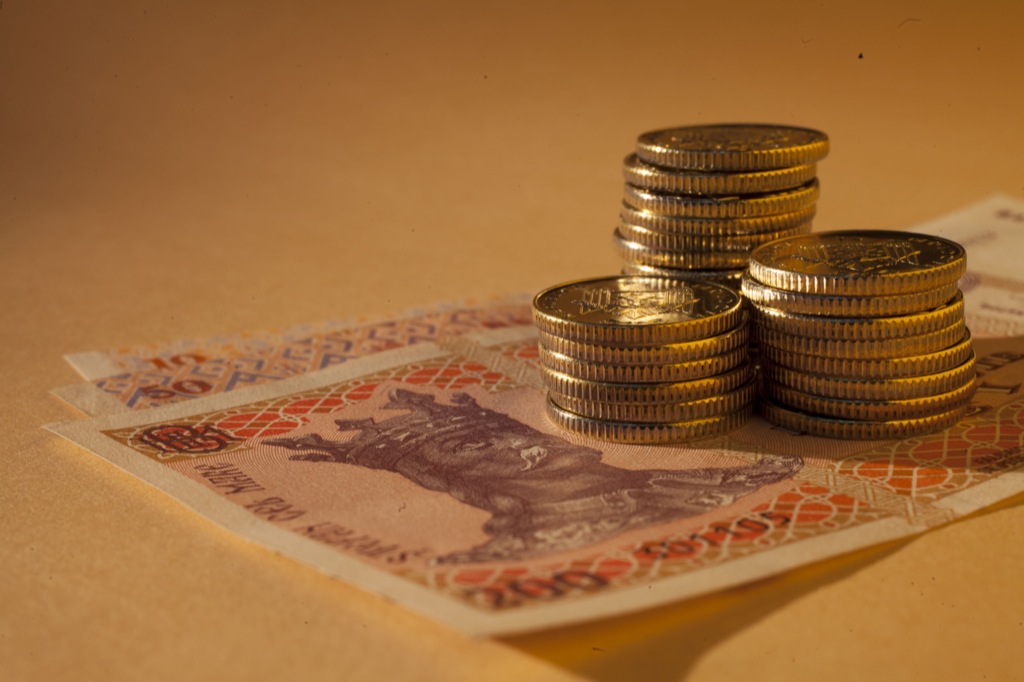
National Bank shall have the exclusive right to issue on the territory of the Republic of Moldova banknotes and coins as legal tender, as well as commemorative and jubilee banknotes and coins as legal tender and for numismatic purposes.

National Bank is exclusively responsible for the licencing, supervision and regulation of financial institutions activity.

National Bank of Moldova acts as banker and fiscal agent of the State and shall receive from state bodies economic and financial information and documents, which are necessary for carrying out its tasks.
National Bank of Moldova is an autonomous public legal entity and is responsible to the Parliament.

National Bank shall inform the public on the monetary policy strategy on the results of the macroeconomic analysis, the evolution of the financial market and on statistics, including with regard to monetary supply, crediting, balance of payments and the state of the foreign exchange market.

National Bank of Moldova is responsable for the compilation of the balance of payments, international investment position and the statistics of the external debt of the Republic of Moldova.


Today, 4 June 2026, the Governor of the National Bank of Moldova (NBM), Ms Anca Dragu, participated in the EU-Moldova Investment Conference 2026, an event held in Chişinău in the presence of the European Commissioner for Enlargement and European Neighbourhood Policy, Ms Marta Kos, alongside the leadership of the Republic of Moldova.
The forum brought together business representatives, international decision-makers, financial institutions and European partners for a dialogue focused on strengthening investment and accelerating the Republic of Moldova’s European economic integration.
During the high-level discussion with Prime Minister Alexandru Munteanu on financing the Republic of Moldova’s economic growth, Ms Anca Dragu highlighted the country’s investment opportunities and the role of the financial sector in supporting economic development. The NBM Governor emphasised that the Republic of Moldova is entering a new stage of development, in which financial stability, structural reforms and convergence with European standards are creating a solid foundation for investment.
“The Republic of Moldova’s financial infrastructure is evolving, digital payments are expanding, and the European integration process is delivering tangible results. Operational connectivity to SEPA in October 2025 marked an important step towards deeper European financial integration, contributing to the development of a more connected, competitive and firmly anchored economy within the European space. Alignment with the EU acquis in banking and financial regulation is also progressing at an accelerated pace. Together, these developments demonstrate that reforms, financial modernisation and European integration are strengthening the Republic of Moldova’s resilience and creating an increasingly attractive investment environment, where private capital finds stability, predictability and genuine access to the European market,” said Ms Anca Dragu.
A key message addressed to investors concerned the strengthening of the regulatory and supervisory framework. The NBM continues its process of alignment with European Union standards, including efforts aimed at securing recognition of prudential framework equivalence by the European Banking Authority. This process sends a clear signal of the Republic of Moldova’s commitment to building a financial sector aligned with European practices.
The NBM Governor stressed that these developments offer investors tangible advantages: a stable financial system, modern payment infrastructures, lower costs for cross-border transactions, predictable regulation, and opportunities in areas such as lending, green finance, the digitalisation of financial services and capital market development.
At the same time, the Republic of Moldova now offers investors a banking sector with predominantly European ownership, strong prudential indicators, solid profitability and a regulatory framework that is becoming increasingly aligned with that of the European Union. As accession negotiations advance, the regulatory environment is becoming more familiar, more predictable and more closely aligned with the EU acquis, creating better conditions for investment planning and expansion.
The Republic of Moldova’s financial market presents significant opportunities for the deepening of lending, capital market development, sustainable finance and the expansion of digital payments aligned with European standards. The taxonomy for sustainable finance, approved by the Government in April 2026 and harmonised with the European framework, creates the conditions for directing ESG capital towards investment projects in the Republic of Moldova.
Ms Anca Dragu also noted that the integration of payment systems and the modernisation of financial infrastructure provide concrete operational advantages for companies already operating in or considering investment in the Republic of Moldova. Cross-border euro payments have become faster and more accessible through connectivity to SEPA, while the development of the MIA instant payment system is strengthening the country’s local digital infrastructure. At the same time, the regulatory framework for fintech, including open banking, e-KYC and strict customer authentication, has created conditions that did not exist three years ago and has enhanced the attractiveness of the Moldovan financial market.
“These transformations form part of a clear European integration trajectory, opening up new opportunities for facilitating investment, developing the financial market and connecting the Republic of Moldova to the economy of the European Union. The National Bank of Moldova remains a promoter of stability, modernisation and European financial integration - essential conditions for a more competitive, resilient and attractive economy for investment,” concluded the NBM Governor.
The EU-Moldova Investment Conference 2026, organised by the Government of the Republic of Moldova and the European Commission, with the support of the Investment Agency and the Ministry of Economic Development and Digitalisation of the Republic of Moldova, serves as a platform for dialogue between public authorities, investors and European partners, while also sending a strong signal of confidence in the Republic of Moldova’s potential. The event confirms that the country is becoming increasingly integrated into the European economic agenda and that the reforms implemented in recent years are creating genuine conditions for attracting investment, fostering business development and strengthening a modern economy.


