Welcome to the official website of the National Bank of Moldova!
×
Do you have good eyesight and want to turn this tool off?



Welcome to the official website of the National Bank of Moldova!
You can choose one of the most popular reports from the list:

National Bank and the members of its decision-making bodies shall be independent in exercising the tasks conferred upon them by law, and shall neither seek nor take instructions from public authorities or from any other authority.
In order to ensure and maintain price stability over the medium term, the National Bank’s aim will be to keep inflation (measured by Consumer Price Index) at the level of 5.0 percent annually with a possible deviation of ± 1.5 percentage points, considered to be optimal for growth and development of Moldova's economy over the medium-term.

Financial stability is achieved by strengthening the resilience of the financial system, limiting the contagion effect and reducing the accumulation of systemic risks, thus contributing to the sustainability of the financial sector and economic growth.
National Bank shall have the exclusive right to issue on the territory of the Republic of Moldova banknotes and coins as legal tender, as well as commemorative and jubilee banknotes and coins as legal tender and for numismatic purposes.

National Bank is exclusively responsible for the licencing, supervision and regulation of financial institutions activity.

National Bank of Moldova acts as banker and fiscal agent of the State and shall receive from state bodies economic and financial information and documents, which are necessary for carrying out its tasks.
National Bank of Moldova is an autonomous public legal entity and is responsible to the Parliament.

National Bank shall inform the public on the monetary policy strategy on the results of the macroeconomic analysis, the evolution of the financial market and on statistics, including with regard to monetary supply, crediting, balance of payments and the state of the foreign exchange market.

National Bank of Moldova is responsable for the compilation of the balance of payments, international investment position and the statistics of the external debt of the Republic of Moldova.
Inflation Report no.4, November 2014
The year 2014 was marked by a series of economic sanctions between West and East that have reinforced the uncertainty and risks in the region. Therefore, the revival prospects announced by the international institutions forecasts for the European economy and Russian economy were effaced by mutual sanctions imposed during the year.
In addition to external environment deterioration, which means a negative influence on exports and remittances, the prospects of the Republic of Moldova economic activity were revised downwardly following the embargoes on exports of some products as of autumn 2013, which have been extended during this year in the context of preparation and signing of the Association Agreement with EU. These sanctions came as a response of the Russian Federation to the signing of the Association and Free Trade Agreement of the Republic of Moldova with the European Union as to protect the Russian market from the European products that might come into the market through the Republic of Moldova, given that the Russian sanitary service „Rospotrebnadzor” declared that Moldovan products do not comply with Russian quality standards. The impact of these sanctions has already been felt partially at the end of the previous year and during the first half of this year, which will also represent an impediment in the economic activity in the coming up periods. However, the degree of their intensity will be largely determined by the efforts of producers and authorities to shift toward alternative markets.
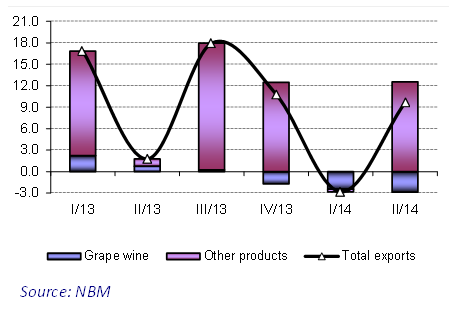
Thus, the series of sanctions started in September 2013 when the Russian Federation imposed a ban on wine import from the Republic of Moldova, accusing its poor quality. This ban came shortly after the officials from Moscow said that the association of the Republic of Moldova with the EU will affect the trade between the two countries. (It should be mentioned that Russia imposed a similar ban in 2006 and then the Moldovan wines returned gradually on the Russian market). The effect of this measure could be felt in the foreign trade and, therefore, in the GDP growth at the end of the previous year, so that the annual growth rate of exports of wines, which were mostly oriented towards Russia, began to turn negative. In the fourth quarter of 2013, the wine exports declined by 21.9 percent, generating a negative contribution of minus 1.7 percentage points in total exports dynamicsExpressed in U.S.dollar according to the balance of payments of the Republic of Moldova (Chart no. 1). The effect of the ban emphasized in 2014. In the first quarter, the wine exports registered a strong decline (minus 38.0 percent) and their negative contribution was so significant that turned negative the annual rate of total exports (minus 2.8 percent). The decline of wine exports also continued in the second quarter of 2014 (minus 36.9 percent). However, their significant negative contribution (minus 2.9 percentage points) was offset by the exports of other products, so that the total exports increased by 9.7 percent, being a determinant factor of the economic growth of this period. It should be mentioned that, in consequence of this embargo, the exported wine production decreased by USD 40.72 million during nine months, which represents about 0.5 percent of GDP..
In the first part of 2014, the Russian Federation threatened to take more measures to protect the Russian economy in case of signing the Association Agreement between the European Union and the Republic of Moldova.
Next embargo was imposed in April 2014. Thus, the Federal Service for Veterinary and Phytosanitary Supervision of the Russian Federation interdicted the import of processed meat from the Republic of Moldova for the non-compliance with the Customs Union norms. However, its impact was limited, taking into account the relative low volume of exports of cold meats and meat on the Russian market.
In July, after signing the Association Agreement, the Russian sanitary service „Rospotrebnadzor” decided to interdict the import of canned fruits and vegetables from the Republic of Moldova. The administration of „Rospotrebnadzor” argued its decision referring to the violation of the Russian legislation on consumers’ rights protection, without providing specific details.
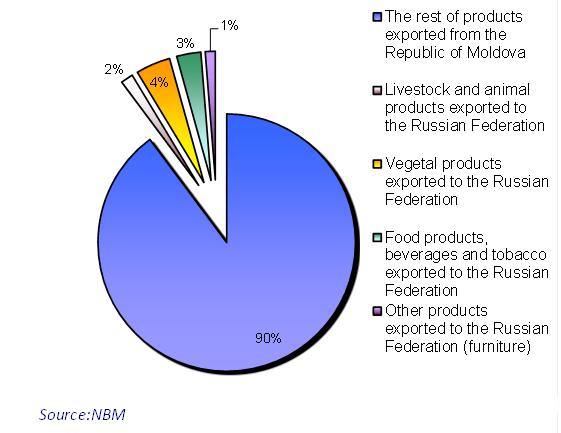
At the same time, on August 1, 2014, the Prime Minister of the Russian Federation signed a decision on imposing new economic barriers on imports of goods from the Republic of Moldova. The decision (which entered into force on September 1, 2014) provides customs duties for 19 categories of products, including fruits, vegetables, wine, meat, cereals, sugar and furniture. These duties are equal to those applied on countries that are not part of the Customs Union.
The effect of embargo on canned fruits and vegetables and that of customs duties on imports of some products from the Republic of Moldova will be felt in the second half of 2014 and in the next year. According to the structure of exports of the Republic of Moldova, the goods exported to the Russian Federation, which are affected by the interdictions and customs duties, represented about 10.0 percent of the total export of the Republic of Moldova in 2013. This fact outlines, with some approximation, the maximum potential impact of these embargoes (Chart no.2).
This impact is to be mitigated by the decision of the European Union to double the export quotas for Moldovan fruits. At the same time, the European Commission proposed that the provisional application of the Free Trade Agreement with the European Union to enter into force on September 1, and doubled the export quotas for three types of Moldovan fruits, as an exceptional measure, since August 1, until the end of 2015.


