Welcome to the official website of the National Bank of Moldova!
×
Do you have good eyesight and want to turn this tool off?



Welcome to the official website of the National Bank of Moldova!
You can choose one of the most popular reports from the list:

National Bank and the members of its decision-making bodies shall be independent in exercising the tasks conferred upon them by law, and shall neither seek nor take instructions from public authorities or from any other authority.

In order to ensure and maintain price stability over the medium term, the National Bank’s aim will be to keep inflation (measured by Consumer Price Index) at the level of 5.0 percent annually with a possible deviation of ± 1.5 percentage points, considered to be optimal for growth and development of Moldova's economy over the medium-term.

Financial stability is achieved by strengthening the resilience of the financial system, limiting the contagion effect and reducing the accumulation of systemic risks, thus contributing to the sustainability of the financial sector and economic growth.
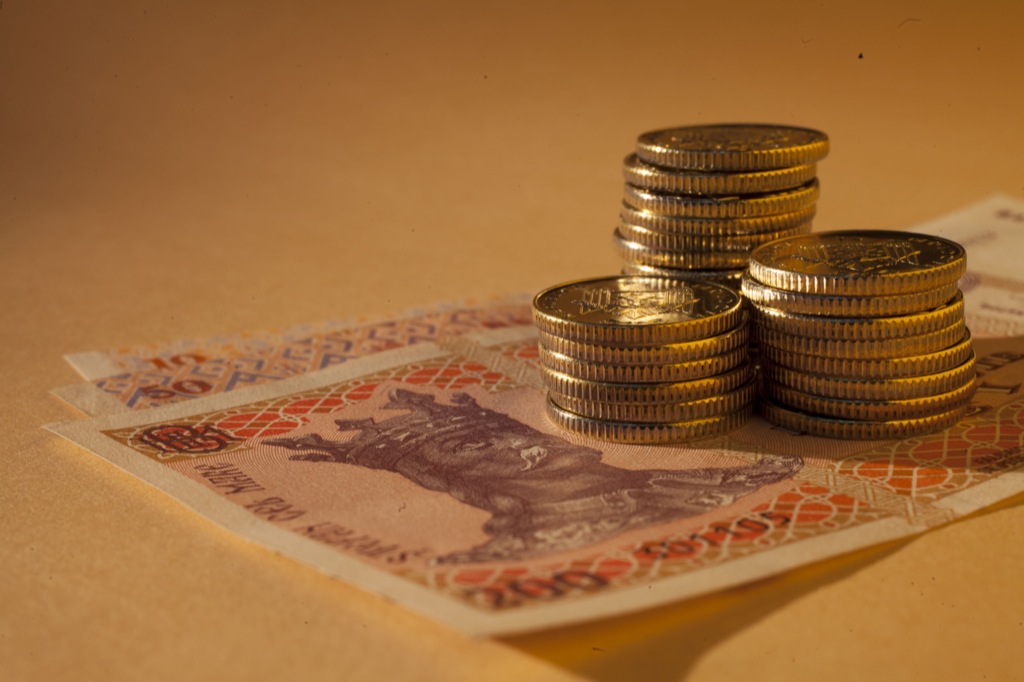
National Bank shall have the exclusive right to issue on the territory of the Republic of Moldova banknotes and coins as legal tender, as well as commemorative and jubilee banknotes and coins as legal tender and for numismatic purposes.

National Bank is exclusively responsible for the licencing, supervision and regulation of financial institutions activity.

National Bank of Moldova acts as banker and fiscal agent of the State and shall receive from state bodies economic and financial information and documents, which are necessary for carrying out its tasks.
National Bank of Moldova is an autonomous public legal entity and is responsible to the Parliament.

National Bank shall inform the public on the monetary policy strategy on the results of the macroeconomic analysis, the evolution of the financial market and on statistics, including with regard to monetary supply, crediting, balance of payments and the state of the foreign exchange market.

National Bank of Moldova is responsable for the compilation of the balance of payments, international investment position and the statistics of the external debt of the Republic of Moldova.
Author: Alexandru Monahov, National Bank of Moldova
This paper introduces a Dynamic Behavioral Equilibrium Exchange Rate (DBEER) model designed specifically for small, open economies, using Moldova as a primary case study. While traditional BEER models are effective for long-term analysis, they often fail to capture short-term volatility and structural shifts. The proposed DBEER model bridges this gap by employing rolling window estimations. Furthermore, the paper finds that adding Remittances/GDP as a regressor significantly improves the outcome of the model for small, open economies.
The paper also introduces two novel performance metrics – the Dynamic Partial R2 and Relative Dynamic Partial R2 – which allow policymakers to quantify the evolving importance of different economic drivers over time, rather than relying on a static average of explanatory power.
Key Findings:
Note: The views expressed in this paper are entirely those of the author and do not in any way imply or represent the views of the National Bank of Moldova. All rights reserved. Reproduction of the information is permitted solely for educational and non-commercial purposes and only where the source is acknowledged.


