Accessibility options

  • Schedule of reception of citizens by the Executive Board of the National Bank of Moldova.
    The registration of applicants for an audience is carried out based on a written request on the subject addressed.


  • Anca Dragu, Governor

    1st Wednesday of the month: 14.00-16.00.


  • Petru Rotaru, First Deputy Governor

    2nd Wednesday of the month: 14.00-16.00.


  • Tatiana Ivanicichina, Deputy Governor

    3rd Wednesday of the month: 14.00-16.00.


  • Constantin Șchendra, Deputy Governor

    4th Wednesday of the month: 14.00-16.00.


  • Mihnea Constantinescu, Deputy Governor

    5th Wednesday of the month: 14.00-16.00.

Please, note the requirements for receiving and examining petitions and requests for access to information of public interest addressed to the National Bank of Moldova!

Details


Main navigation BNM

Calendar of data dissemination

20.10.2026
  • Publication of the statistics Monetary survey of the banking sector.

  • Publication of the statistics: "Average rates and volumes of new loans granted and new deposits attracted", "Annual weighted average interest rates on new loans granted and new deposits attracted and related volumes including", "Average interest rates on loan and deposit balances", "Weighted average interest rates on interbank transactions".

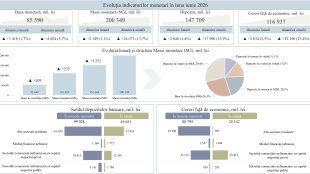
  • Publication of the monthly press-realease "Evolution of monetary indicators".

  • Publication of the monthly releases "Developments in the bank credit market" and "Developments in the bank deposit market".

  • Publication of the monthly press-release "Evolution of the volume of cash operations".

  • Publication of statistical reports on financial reports on the banking sector: "Balance Sheet on the banking sector", "Income Statement", "The structure of deposits in the banking sector" and "Volume of cash transactions in the banking system of the Republic of Moldova".

Annual inflation

The annual rate of inflationAnnual inflation rate represents the increase of consumer prices during a month this year compared with the same month last year. It is calculated as a ratio (expressed in percentage terms) between the price index during a month this year and price index during the same month last year, calculated on the same basis, minus 100. Statistical surveys on consumer prices are carried out by the National Bureau of Statistics (NBS). NBM sets its inflation target at the level of 5.0 percent annually, calculated based on the consumer price index (inflation rate for the last twelve months – each month of this year compared with the same month of last year), with a possible deviation of ±1.5 percentage points. (Source: Medium-term monetary policy strategy of the NBM. in September 2026 was 8,60 percent.


NBM Interest rates

17.09.2026 - Today
  • Base rate9.00%
  • Overnight deposits7.00%
  • Repo rate9.25%
  • Overnight credits11.00%

The base rate is approved as the reference rate for the main short-term monetary policy operations. The deposit and lending facility is part of a symmetrical corridor of ± 2 p.p. to the base rate.

The NBM aims to reduce inflationary pressures, mitigate the secondary effects of supply shocks, encouraging saving rather than consumption, and anchoring inflation expectations with a view to bringing the annual inflation rate back within a range of ±1.5 percentage points of the medium-term inflation target of 5.0 per cent.

The current inflation forecast, compared with that in the previous inflation report has been revised upwards for the entire comparable period with the exception of the fourth quarter of 2027 and the first quarter of 2028, when it was revised downwards.

In August 2026, the monetary base amounted to MDL 86,337 million, which represents an increase by 2.0% compared to July 2026.

New loans granted in August 2026 amounted to MDL 7,241 million, of which 64.4% were contracted by businesses and individuals engaged in economic activities and 35.6% by individuals.

New deposits attracted in August 2026 amounted to MDL 27,085 million, with 68.5% being placed by the businesses and individuals engaged in economic activities and 31.5% by individuals.

In July 2026, the monetary base amounted to MDL 84,641 million, which represents a decrease by 1.1% compared to June 2026.

New loans granted in July 2026 amounted to MDL 7,395 million, of which 62.4% were contracted by businesses and individuals engaged in economic activities and 37.6% by individuals.

New deposits attracted in July 2026 amounted to MDL 30,678 million, with 71.6% being placed by the businesses and individuals engaged in economic activities and 28.4% by individuals.

The NBM reiterates that it will continue to closely monitor the developments in the domestic and international environment, the risks and uncertainties associated with the evolution of inflation in the short and medium term and will use, if necessary, the available instruments to achieve its fundamental objective.

In June 2026, the monetary base amounted to MDL 85,590 million, which represents an increase by 1.7% compared to May 2026.

New loans granted in June 2026 amounted to MDL 8,321 million, of which 65.2% were contracted by businesses and individuals engaged in economic activities and 34.8% by individuals.

New deposits attracted in June 2026 amounted to MDL 28,769 million, with 69.3% being placed by the businesses and individuals engaged in economic activities and 30.7% by individuals.

In May 2026, the monetary base amounted to MDL 84,172 million, which represents an increase by 0.5% compared to April 2026.

New loans granted in May 2026 amounted to MDL 7,333 million, of which 63.9% were contracted by businesses and individuals engaged in economic activities and 36.1% by individuals.

New deposits attracted in May 2026 amounted to MDL 26,216 million, with 69.0% being placed by the businesses and individuals engaged in economic activities and 31.0% by individuals

The NBM’s decision to continue its restrictive monetary policy measures was adopted in the context of intensifying inflationary pressures stemming both from the supply side, due to unfavourable trends in international prices for energy resources, food products, and raw materials, and from the domestic demand side, supported by favourable dynamics of household income.

At the beginning of 2026, the annual inflation rate will decline, then remain relatively stable until the end of the year. At the beginning of next year it will record a further slight decline, subsequently stabilizing at the same level during the last three consecutive quarters of the forecast period.

See more