Welcome to the official website of the National Bank of Moldova!
×
Do you have good eyesight and want to turn this tool off?



Welcome to the official website of the National Bank of Moldova!
You can choose one of the most popular reports from the list:

National Bank and the members of its decision-making bodies shall be independent in exercising the tasks conferred upon them by law, and shall neither seek nor take instructions from public authorities or from any other authority.

In order to ensure and maintain price stability over the medium term, the National Bank’s aim will be to keep inflation (measured by Consumer Price Index) at the level of 5.0 percent annually with a possible deviation of ± 1.5 percentage points, considered to be optimal for growth and development of Moldova's economy over the medium-term.

Financial stability is achieved by strengthening the resilience of the financial system, limiting the contagion effect and reducing the accumulation of systemic risks, thus contributing to the sustainability of the financial sector and economic growth.
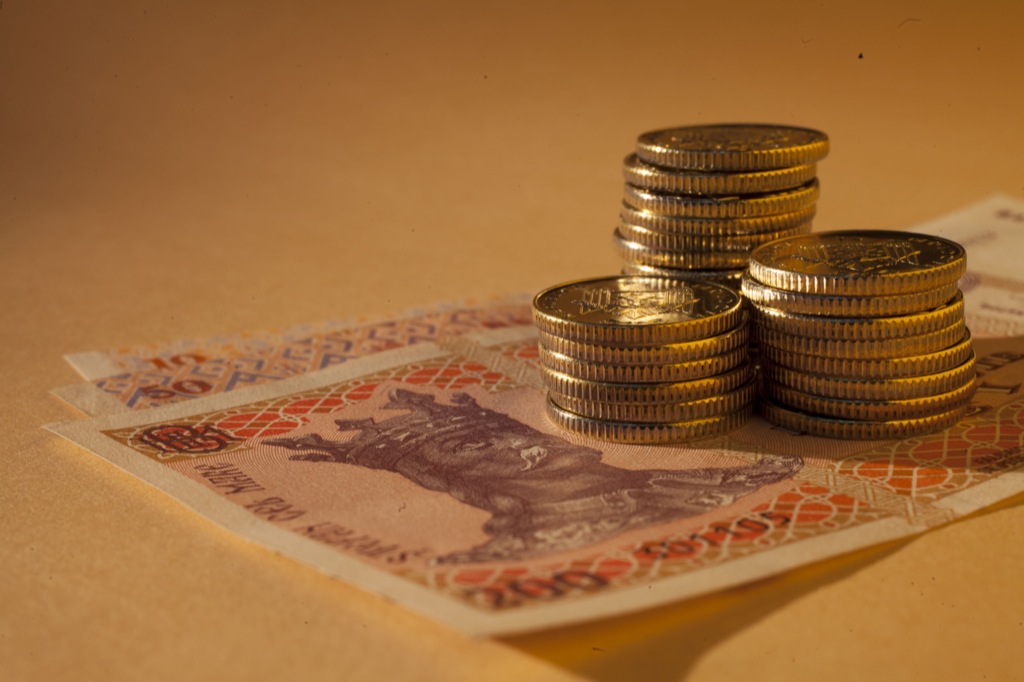
National Bank shall have the exclusive right to issue on the territory of the Republic of Moldova banknotes and coins as legal tender, as well as commemorative and jubilee banknotes and coins as legal tender and for numismatic purposes.

National Bank is exclusively responsible for the licencing, supervision and regulation of financial institutions activity.

National Bank of Moldova acts as banker and fiscal agent of the State and shall receive from state bodies economic and financial information and documents, which are necessary for carrying out its tasks.
National Bank of Moldova is an autonomous public legal entity and is responsible to the Parliament.

National Bank shall inform the public on the monetary policy strategy on the results of the macroeconomic analysis, the evolution of the financial market and on statistics, including with regard to monetary supply, crediting, balance of payments and the state of the foreign exchange market.

National Bank of Moldova is responsable for the compilation of the balance of payments, international investment position and the statistics of the external debt of the Republic of Moldova.
The International Monetary Fund (IMF) is an international organization whose objective is to promote international monetary cooperation, encourage the expansion and balanced growth of international trade, as well as to promote currency stability. The Republic of Moldova accepted the IMF Statute by the Parliament Decision No. 1107/1992, and on 12 August 1992 it became a member of the IMF.
Being the fiscal agency of the Republic of Moldova within the IMF, the NBM is authorized to carry out, on behalf of the Republic of Moldova, all operations and transactions authorized according to the IMF Statute.
Within the IMF, the Republic of Moldova is part of the group of countries (constituency) that includes Andorra, Armenia, Belgium, Bosnia and Herzegovina, Bulgaria, Cyprus, Croatia, Georgia, Israel, Luxembourg, the Republic of North Macedonia, Montenegro, Romania, the Kingdom of the Netherlands and Ukraine.
The position of governor of the Republic of Moldova within the Board of Governors of the IMF is held by the Governor of the NBM, while that of alternate governor is held by the First Deputy Governor of the NBM.
The current quota of the Republic of Moldova in the IMF is 172.5 million Special Drawing Rights (SDR), which represents 0.04 percent of the IMF's capital. This quota entered into force on 17 February 2016, after the Republic of Moldova increased its previous quota of SDR 123.2 million. The respective increase occurred in the context of 2 important reforms initiated by the IMF in 2010 – the Fourteenth General Review of Quotas and the Reform of the IMF Executive Board. Resulting from the implementation of the above-mentioned reforms, the capital of the IMF has been doubled (from 238.5 billion SDR to 477 billion SDR), the quotas of the member countries have been adjusted to more accurately reflect their position in the global economy, and the IMF Executive Board has become more representative. Our country has expressed its support for these reforms by adopting Law on the increase of the Republic of Moldova’s quota subscription in the International Monetary Fund No.109/2012 and Law for accepting the Amendment to the Statute of the International Monetary Fund on the reform of the IMF Executive Board No. 118/2012.
On 30 June 1995, Moldova accepted the provisions of Article VIII of the IMF Statute. Hereby, the Republic of Moldova shall not impose restrictions on the making of payments and transfers for current international transactions or engage in discriminatory currency arrangements or multiple currency practices, without the approval / consultation of the IMF.
Since joining the IMF, the Republic of Moldova has been benefiting from the financial assistance of this organization for supporting various economic programs and policies of the national authorities. This assistance has been provided by means of the following IMF financing instruments: Compensatory and Contingency Financing Facility (CCFF), Systemic Transformation Facility (STF), Stand-By Arrangement (SBA), Extended Fund Facility (EFF), Poverty Reduction and Growth Facility (PRGF), which since 2009 has been called Extended Credit Facility (ECF), Rapid Credit Facility (RCF), Rapid Financing Instrument (RFI).
Annually, the IMF grants the Republic of Moldova consultations in the area of economic and financial policy, according to the provisions of Article IV of the IMF Statute, which regulates the cooperative relations between member countries and the IMF.
The NBM is an active participant within the Special Data Dissemination Standard (SDDS), the Republic of Moldova subscribed to in May 2006. Periodically, data on economic and financial indicators are made available to the public in order to ensure the transparency of the country's macroeconomic policies and performances.
Following the consequences of the financial crisis of 2008, the IMF extended the project on Financial Soundness Indicators (FSI), inviting several countries, including the Republic of Moldova, to participate in the nominated project. The NBM was designated as the institution responsible for compiling the information related to the FSI and its submission to the IMF. The core objective of the FSI is to promote macroprudential analysis and assess the strengths and vulnerabilities of financial systems.
As part of the policies for evaluating the degree of adoption of international standards in the fields relevant to the IMF's activity, the Republic of Moldova participated in various programs, including:
The announcements of the IMF representative office in the Republic of Moldova, the policy programs agreed with the IMF, the reports, as well as other information are available on the website of the IMF:


