Welcome to the official website of the National Bank of Moldova!
×
Do you have good eyesight and want to turn this tool off?



Welcome to the official website of the National Bank of Moldova!
You can choose one of the most popular reports from the list:

National Bank and the members of its decision-making bodies shall be independent in exercising the tasks conferred upon them by law, and shall neither seek nor take instructions from public authorities or from any other authority.

In order to ensure and maintain price stability over the medium term, the National Bank’s aim will be to keep inflation (measured by Consumer Price Index) at the level of 5.0 percent annually with a possible deviation of ± 1.5 percentage points, considered to be optimal for growth and development of Moldova's economy over the medium-term.

Financial stability is achieved by strengthening the resilience of the financial system, limiting the contagion effect and reducing the accumulation of systemic risks, thus contributing to the sustainability of the financial sector and economic growth.

National Bank shall have the exclusive right to issue on the territory of the Republic of Moldova banknotes and coins as legal tender, as well as commemorative and jubilee banknotes and coins as legal tender and for numismatic purposes.

National Bank is exclusively responsible for the licencing, supervision and regulation of financial institutions activity.

National Bank of Moldova acts as banker and fiscal agent of the State and shall receive from state bodies economic and financial information and documents, which are necessary for carrying out its tasks.

National Bank of Moldova is an autonomous public legal entity and is responsible to the Parliament.

National Bank shall inform the public on the monetary policy strategy on the results of the macroeconomic analysis, the evolution of the financial market and on statistics, including with regard to monetary supply, crediting, balance of payments and the state of the foreign exchange market.

National Bank of Moldova is responsable for the compilation of the balance of payments, international investment position and the statistics of the external debt of the Republic of Moldova.
The financial situation of the banking sector remains robust, reflecting the ongoing measures taken by the National Bank of Moldova (NBM) to strengthen stability and increase confidence in the banking system.
During the first quarter of 2026, according to data reported by banks, the banking sector was characterised by growth in assets, loans, and deposits from individuals and legal entities. At the same time, banks complied with prudential requirements, maintaining key indicators at appropriate levels and demonstrating a strong capability to adapt and strengthen their capital.
At the same time, the National Bank of Moldova continued to promote important reforms in the areas of banking regulation and legislative harmonisation, in line with European Union standards and Basel III requirements, contributing to the modernisation of the financial system and the advancement of the European integration process.
As of 31 March 2026, the situation in the banking sector, as reflected in the reports submitted by the banks, showed the following trends:
Total assets amounted to MDL 196,765.8 million, increasing by 3.6% (MDL 6,867.7 million) during the first quarter of 2026.
In the asset structure, the largest share was accounted for by loans and advances at amortised cost, which amounted to 55.3% (MDL 108,743.8 million), followed by the share of banks’ investments in state securities and NBM certificates - 17.4% (MDL 34,164.7 million), the share of funds placed with the NBM stood at 14.1% (MDL 27,841.7 million), and the share of other the assets (cash, funds in other banks, tangible assets, intangible assets etc.) - 13.2% (MDL 26,015.6 million).
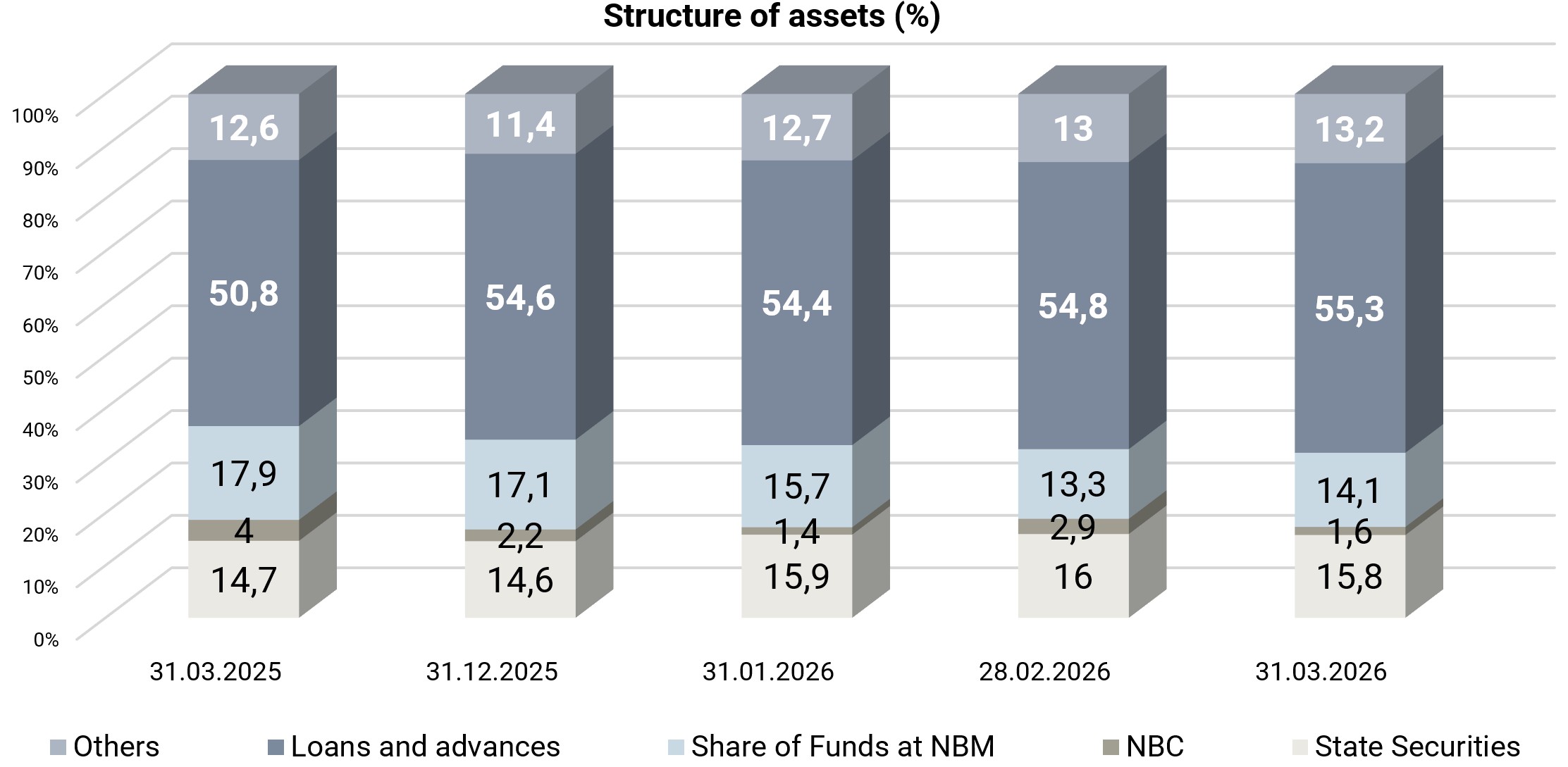
The gross (prudential) balance of loans accounted for 55.2% of total assets, or MDL 108,635.8 million, increasing by 5.6% (MDL 5,794.9 million) during the period under review.
The largest share of the total loan portfolio, in terms of risk distribution by sector, was accounted for by loans granted for the purchase/construction of real estate – 25.2% (MDL 27,391.4 million), loans granted to trade – 20.8% (MDL 22,603.7 million) and consumer loans — 18.4% (MDL 19,982.8 million).
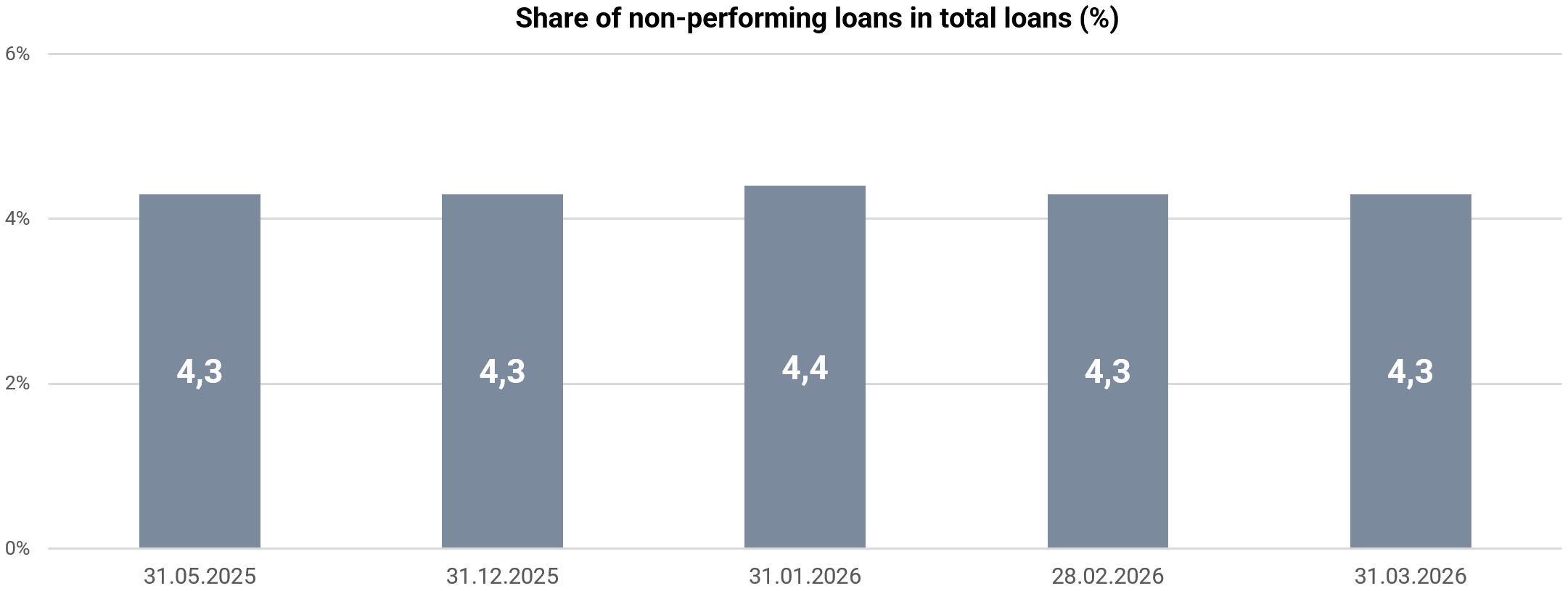
The ratio of non-performing loans to total loans (prudential) stood at 4.3%, and the share of non-performing loans in total loans (IFRS) was 1.5%.
At the same time, the share of expired loans (loans with payments more than 30 days past due) in total was 1.5%.
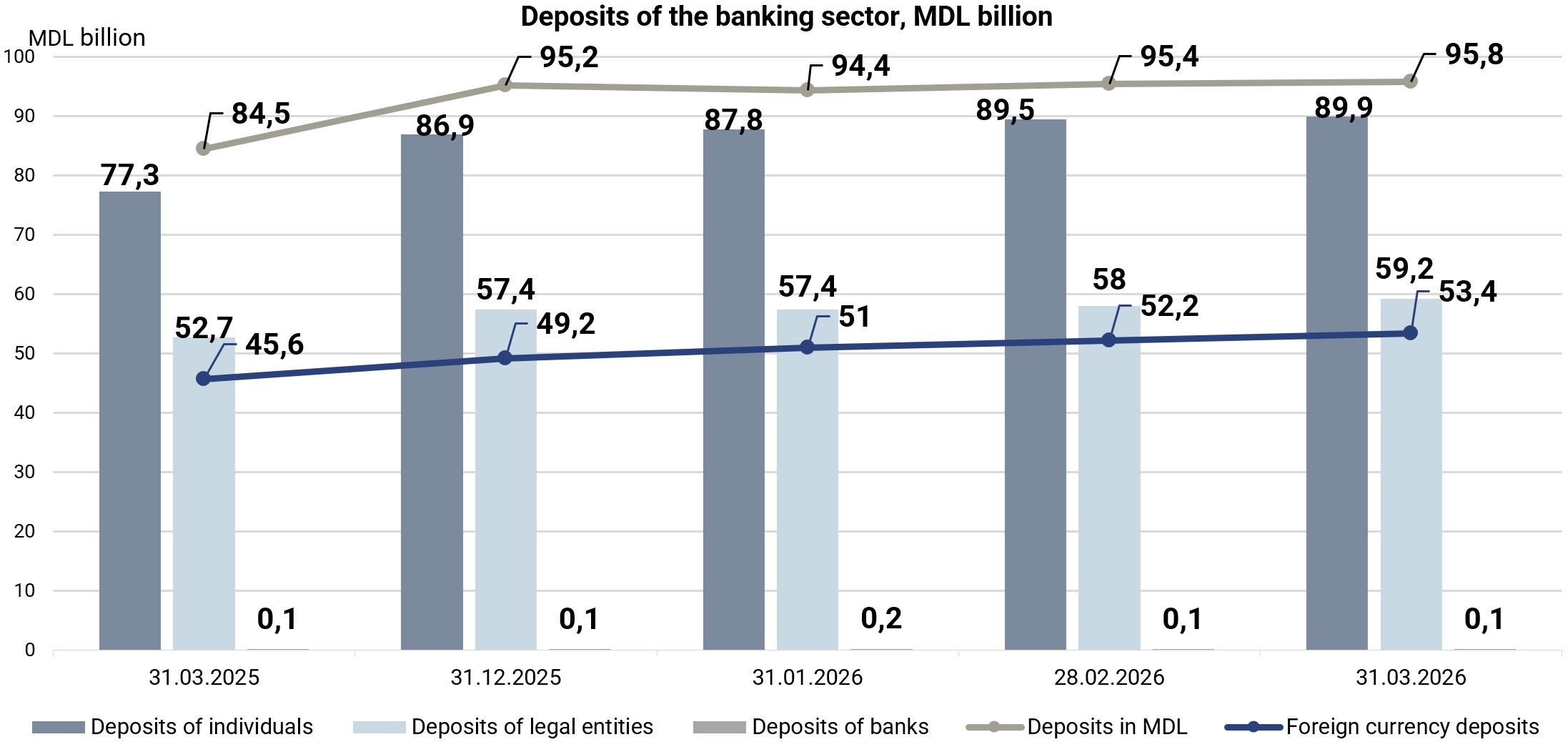
The total balance of deposits increased compared to the end of the previous year by MDL 4,796.4 million, or 3.3%, reaching MDL 149,219.2 million (deposits of individuals accounted for 60.2% of total deposits, deposits of legal entities—39.7%, and bank deposits - 0.1%), as a result of an increase in the balance of deposits of individuals by MDL 3,041 million (3.5%), to MDL 89,908.7 million, and in the balance of deposits of legal entities by MDL 1,814.3 million (3.2%), to MDL 59,252.7 million. At the same time, deposits of banks decreased by MDL 58.9 million (50.5%), to MDL 57.7 million.
Of the total deposits, 64.2% were in MDL, their balance increasing by MDL 524.1 million (0.6%) compared to the end of the previous year and totalling MDL 95,766.2 million as of 31 March 2026. Foreign currency deposits, meanwhile, accounted for 35.8% of total deposits; their balance also increased during the first quarter of 2026 by MDL 4,272.2 million (8.7%), totalling MDL 53,452.9 million.
As of 31 March 2026, according to data provided by the banks, the banking sector’s profit amounted to MDL 1,158.2 million, an increase of MDL 117.6 million (11.3%) compared to the same period of the previous year, primarily as a result of a MDL 628.1 million (25.6%) increase in interest income, to MDL 3,078 million, due to a MDL 454.1 million (25.1%) rise in income from lending activities, to MDL 2,266.4 million.
Profitability indicators point to a stable and efficient banking sector, with solid profitability and a good resource utilisation capacity. Thus, return on assets was 2.3%, and return on equity was 14.7%.
Throughout the first quarter of 2026, banks maintained their liquidity ratios at a high level, above the regulatory limits. Accordingly, all banks complied with the prudential liquidity ratios.
The net stable funding ratio (NSFR, effective as of 30 September 2025), which represents the ratio of a bank’s available stable funding to its required stable funding, stood at 167.5% as of 31 March 2026 (limit ≥ 100%). This ratio has ranged from 145.2% to 339.9%.
The liquidity coverage ratio (LCR) by sector stood at 299.8% (limit ≥ 100%), ranging from 137.4% to 839.9%, depending on the bank.
According to reports submitted by banks as of 31 March 2026, the total own funds ratio for the banking sector recorded a value of 22.3%, down 1 percentage points compared to the end of the previous year, as a result of an increase in total risk exposure by MDL 5,051.9 million (5%) (due to growth in the loan portfolio). This indicator varied between 20% and 36%, depending on the bank. All banks complied with the “Total own funds ratio” indicator (limit ≥ 10%).
In addition, the banks complied with the requirement related to the “Total own funds ratio” indicator, taking into account capital buffers.
As at 31 March 2026, total own funds amounted to MDL 23,638.2 million, an increase of 0.5% (MDL 111.7 million). The increase in own funds was driven by the rise in subordinated loans from a bank.
As of 31 March 2026, the banks complied with the prudential indicators on large exposures and exposures to their related persons.
During the reporting period, banks complied with the limit of dominant position in the banking market, remaining below the 35% limit of this indicator based on the size of assets and deposits of individuals, with the exception of one bank, which exceeded the 35% limit of dominant position based on the size of assets, reaching 37.5%, and the dominant position in the banking market based on the size of deposits of individuals stood at 36.2%.
During the first quarter of 2026, the National Bank of Moldova (NBM) continued its efforts to draft and update secondary normative acts to implement Law No 202/2017 on the activity of banks, promote the Basel III requirements, and foster best practices in this area.
In this regard, Decision of the Executive Board of the NBM No 38/2026 approved amendments to Regulation No 111/2018 on the treatment of banks' credit risk using standardised approach. Changes to the prudential treatment of credit risk using standardised approach were introduced through the transposition of the CRR III provisions. These changes will take effect on 1 July 2027 and will increase the granularity of exposure classes, while reducing reliance on external credit assessments (ECAI). Risk weights for exposures secured by mortgages on real estate are based on the exposure-to-value ratio. The concept of ADC exposure (land acquisition, development, and construction) has been introduced, along with exposures to a single trader, other retail exposures, and exposures arising from specialised financing. In addition, new exposure classes have been added, including exposures from subordinated debt and exposures in the form of covered bonds.
In addition, by Decision of the Executive Board of the NBM No 74/2026, amendments were approved to Regulation No 115/2018 on the treatment of settlement/delivery risk and to Regulation No 116/2018 on the calculation of specific and general credit risk adjustments by banks (effective as of 1 January 2027). The amendments provide for the introduction of provisions related to the application of the IRB approach, with a view to full alignment with EU standards, which will contribute to the development of mechanisms for managing settlement/delivery risk, as well as to an alternative approach regarding the treatment of general and specific adjustments for credit risk.
At the same time, Decision of the Executive Board of the NBM No 75/2026 approved amendments to Instruction No 117/2018 on submission by banks of COREP reports for supervisory purposes. These amendments will take effect on 1 October 2026 and will include some new reports regarding the treatment of counterparty credit risk, particularly for bilateral contracts with derivative financial instruments, repurchase transactions, securities or commodities lending or borrowing transactions, long settlement transactions, and margin lending transactions.
By Decision of the Executive Board of the NBM No 76/2026, amendments were approved to Regulation No 109/2018 on own funds of banks and capital requirements (effective as of 1 July 2027), which introduce provisions regarding the prudential protection mechanism for insufficient coverage of non-performing exposures, as well as provisions regarding own funds and capital requirements related to the IRB approach, securitisations, and eligible liabilities.


