Welcome to the official website of the National Bank of Moldova!
×
Do you have good eyesight and want to turn this tool off?



Welcome to the official website of the National Bank of Moldova!
You can choose one of the most popular reports from the list:
National Bank and the members of its decision-making bodies shall be independent in exercising the tasks conferred upon them by law, and shall neither seek nor take instructions from public authorities or from any other authority.

In order to ensure and maintain price stability over the medium term, the National Bank’s aim will be to keep inflation (measured by Consumer Price Index) at the level of 5.0 percent annually with a possible deviation of ± 1.5 percentage points, considered to be optimal for growth and development of Moldova's economy over the medium-term.

Financial stability is achieved by strengthening the resilience of the financial system, limiting the contagion effect and reducing the accumulation of systemic risks, thus contributing to the sustainability of the financial sector and economic growth.

National Bank shall have the exclusive right to issue on the territory of the Republic of Moldova banknotes and coins as legal tender, as well as commemorative and jubilee banknotes and coins as legal tender and for numismatic purposes.

National Bank is exclusively responsible for the licencing, supervision and regulation of financial institutions activity.
National Bank of Moldova acts as banker and fiscal agent of the State and shall receive from state bodies economic and financial information and documents, which are necessary for carrying out its tasks.
National Bank of Moldova is an autonomous public legal entity and is responsible to the Parliament.

National Bank shall inform the public on the monetary policy strategy on the results of the macroeconomic analysis, the evolution of the financial market and on statistics, including with regard to monetary supply, crediting, balance of payments and the state of the foreign exchange market.

National Bank of Moldova is responsable for the compilation of the balance of payments, international investment position and the statistics of the external debt of the Republic of Moldova.
Raport asupra inflației nr.4, noiembrie 2013
În anul 2010, pentru asigurarea obiectivului de bază - de menţinere şi asigurare a stabilităţii preţurilor, BNM a început să-şi stabilească obiective cantitative privind nivelul inflaţiei anuale, fapt ce a constituit o precondiţie necesară trecerii la regimul de ţintire a inflaţiei. În acest fel, conform Strategiei politicii monetare a Băncii Naţionale a Moldovei pentru 2010-2012, pentru anul 2010 aceasta şi-a propus să orienteze inflaţia spre nivelul de 5.0 la sută, cu o posibilă deviere de ± 1.0 puncte procentuale. În perioada 2011 – 2012 BNM a avut drept scop de a asigura încadrarea inflaţiei în intervalul mijlociu de o singură cifră. Trecerea propriu-zisă la regimul de ţintire directă a inflaţiei s-a produs odată cu publicarea Strategiei politicii monetare pe termen mediu (aprobată prin Hotărîrea Consiliului de administraţie nr.303 din 27 decembrie 2012). Conform strategiei, BNM stabileşte ţinta inflaţiei, calculată în baza indicelui preţurilor de consum, în valoarea de 5.0 la sută anual, cu o posibilă deviere de ± 1.5 puncte procentuale.
Regimul de ţintire directă a inflaţiei reprezintă o strategie de politică monetară care implică 5 elemente principale:
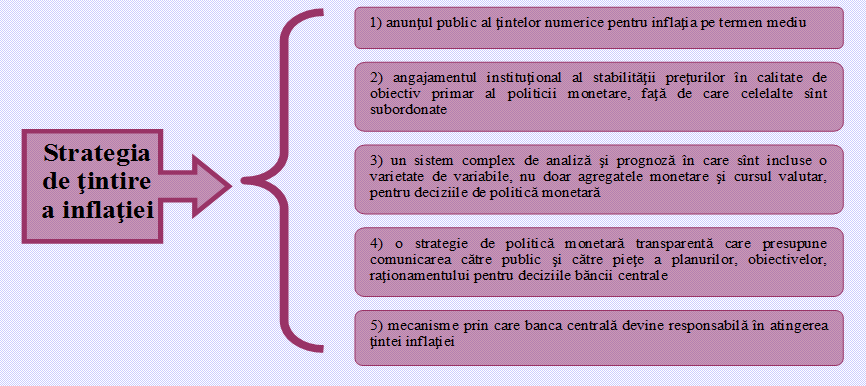
Cu alte cuvinte, regimul de ţintire a inflaţiei nu presupune doar comunicarea publicului a unor valori numerice ale inflaţiei pentru anul viitor. Eficienţa unei astfel de strategii de politică monetară este determinată de existenţa celorlalte patru criterii şi de asigurarea sustenabilităţii acestora.
În acest fel, pe lîngă faptul că valoarea numerică a inflaţiei pe termen mediu este comunicată în cadrul strategiei de politică monetară pe termen mediu, în Republica Moldova sînt îndeplinite şi celelalte elemente sus-menţionate. Astfel, angajamentul instituţional al stabilităţii preţurilor este asigurat de modificările operate în anul 2006 la Legea cu privire la BNM. Totodată, BNM a dezvoltat un sistem amplu de analiză şi prognoză a principalelor variabile macroeconomice pe termen scurt şi pe termen mediu care include o suită de tehnici şi modele econometrice, precum şi un model dinamic de echilibru general care sînt estimate şi calibrate continuu. Criteriul de transparenţă este asigurat de publicarea lunară a comunicatelor cu privire la deciziile de politică monetară, conferinţele de presă şi rapoartele asupra inflaţiei trimestriale în care se prezintă evoluţia şi prognoza inflaţiei în Republica Moldova. În acelaşi timp, BNM în rapoartele sale explică principalii factori care determină abaterea inflaţiei efective de la prognoză, demonstrînd astfel responsabilitatea faţă de angajamentul asumat.
Adoptarea strategiei respective poate fi argumentată prin avantajele pe care aceasta le posedă comparativ cu regimurile de ţintire a cursului de schimb sau a agregatelor monetare. Astfel, ţintirea directă a inflaţiei permite politicii monetare să se concentreze pe situaţia internă şi să reacţioneze la şocuri atît din exterior, cît şi din interior. Strategia de ţintire a inflaţiei permite autorităţii monetare să facă uz de toată informaţia, nu doar de unii indicatori, pentru a determina timpul şi intensitatea acţiunii sale. Totodată, acest regim de politică monetară prezintă un avantaj prin faptul că este mai uşor înţeles de public şi, în acest fel, este mult mai transparent.
|
|
Anul adoptării regimului de ţintire a inflaţiei |
Ţinta inflaţiei pentru 2012, % |
Inflaţia medie în anul 2012, % |
|
Moldova |
2010stabilirea obiectivului cantitativ privind inflația/2013 |
5.0 ±1.5 p.p |
4.6 |
|
România |
2005 |
3.0 ±1.0 p.p |
3.33 |
|
Cehia |
1997 |
2.0 ±1.0 p.p |
3.3 |
|
Polonia |
1998 |
2.5 ±1.5 p.p |
3.7 |
|
Ungaria |
2001 |
3.0 |
5.7 |
BNM a trecut recent la acest regim de politică monetară şi deşi are mai puţină experienţă comparativ cu alte ţări din regiune (vezi tabelul), a reuşit să dezvolte principalele elemente ale acestui regim şi prin intermediul instrumentelor sale să direcţioneze inflaţia către ţinta sa pe termen mediu. Astfel, în ultimii trei ani BNM a reuşit să asigure traiectoria dezinflaţionistă a ritmului anual al IPC, pentru ca începînd cu luna februarie 2012 pînă în prezent, acesta să se încadreze continuu în intervalul de variaţie de ± 1.5 puncte procentuale de la ţinta de 5.0 la sută stipulată în Strategia politicii monetare pe termen mediu.


