Welcome to the official website of the National Bank of Moldova!
×
Do you have good eyesight and want to turn this tool off?



Welcome to the official website of the National Bank of Moldova!
You can choose one of the most popular reports from the list:

National Bank and the members of its decision-making bodies shall be independent in exercising the tasks conferred upon them by law, and shall neither seek nor take instructions from public authorities or from any other authority.
In order to ensure and maintain price stability over the medium term, the National Bank’s aim will be to keep inflation (measured by Consumer Price Index) at the level of 5.0 percent annually with a possible deviation of ± 1.5 percentage points, considered to be optimal for growth and development of Moldova's economy over the medium-term.

Financial stability is achieved by strengthening the resilience of the financial system, limiting the contagion effect and reducing the accumulation of systemic risks, thus contributing to the sustainability of the financial sector and economic growth.

National Bank shall have the exclusive right to issue on the territory of the Republic of Moldova banknotes and coins as legal tender, as well as commemorative and jubilee banknotes and coins as legal tender and for numismatic purposes.

National Bank is exclusively responsible for the licencing, supervision and regulation of financial institutions activity.

National Bank of Moldova acts as banker and fiscal agent of the State and shall receive from state bodies economic and financial information and documents, which are necessary for carrying out its tasks.
National Bank of Moldova is an autonomous public legal entity and is responsible to the Parliament.

National Bank shall inform the public on the monetary policy strategy on the results of the macroeconomic analysis, the evolution of the financial market and on statistics, including with regard to monetary supply, crediting, balance of payments and the state of the foreign exchange market.

National Bank of Moldova is responsable for the compilation of the balance of payments, international investment position and the statistics of the external debt of the Republic of Moldova.
Raport asupra inflației nr.4, noiembrie 2013
Formula modelului macroeconomic deschis caracteristică pentru majoritatea ţărilor implică dependenţa semnificativă a evoluţiei economice de traiectoria variabilelor economice de importanţă internaţională. Respectiv, orice prognoză macroeconomică de nivel naţional, cît şi internaţional are la bază ipotezele evoluţiei variabilelor mediului macroeconomic extern, precizia valorilor estimate ale acestora fiind esenţială pentru obţinerea unor prognoze veridice şi cu deviaţie minimă de la valorile efective. Printre aceste variabile putem menţiona: preţul petrolului, ratele de schimb pentru cele mai importante monede, preţurile internaţionale la materiile prime, indicii bursieri, valoarea acţiunilor etc. O opţiune avantajoasă în procesul de prognoză reprezintă utilizarea valorilor prognozate pentru variabilele menţionate mai sus în baza contractelor futures.
Contractele futures reprezintă contracte standardizate între două părţi de a cumpăra sau vinde un activ la cantitatea standard şi calitatea specificată pentru un preţ convenit astăzi (preţul futures sau preţul de exercitare), cu livrarea şi plata în viitor la o dată specificată (data de livrare). Contractele sînt negociate la burse, care acţionează ca un intermediar între cele două părţi. De aceea, pe lîngă denumirea activului este indicată de cele mai multe ori şi bursa unde se cotează activul, de exemplu ICE Brent Crude Oil – preţul în USD pentru un baril de petrol de marca Brent cotat la platforma electronică Intercontinental Exchange sau CBOT Wheat - preţul în cenţi (SUA) pentru un obroc de grîu cotat la Chicago Board of Trade. În multe cazuri, activul suport la un contract futures poate să nu reprezinte mărfuri tradiţionale, ci active financiare, elementul de bază fiind orice instrument financiar (valută, obligaţiuni). De asemenea, activul suport poate constitui un element activ intangibil sau de referinţă, cum ar fi indicii bursieri sau ratele dobînzilor.
În contextul elaborării prognozelor macroeconomice, apelarea la contractele futures este indispensabilă, elementul primordial constituind frecvenţa relativ înaltă de reflecţie a reacţiei activului cotat la factorii de influenţă a acestora, adică în fiecare minut pe parcursul zilei de lucru a bursei în cauză. Diferenţa dintre indicii de la diferite burse care reflectă modificarea sub acţiunea factorilor de influenţă se datorează fusului orar. Astfel, este inutilă elaborarea unui model macroeconomic de prognoză a preţului la petrol, metale, cereale etc., în condiţiile în care contractele futures pentru activele în cauză reflectă modificările de ultim moment ale cererii şi ofertei pentru activele vizate. Totodată, pentru a obţine prognoze comparabile în timp, este necesară respectarea unei anumite frecvenţe de utilizare a valorilor contractelor futures în cadrul modelului de prognoză.
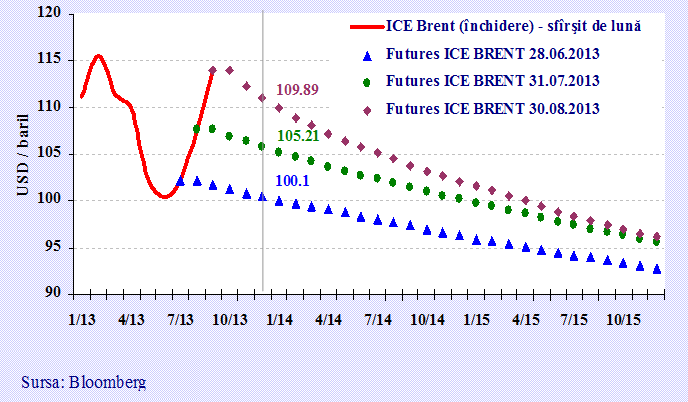
În graficul nr.1 sînt reflectate valorile la închiderea burselor în ultimele zile lucrătoare ale lunilor iunie – august 2013 pentru preţul petrolului de marca Brent. Din grafic se observă că odată cu creşterea preţului spot, cresc semnificativ şi valorile pentru contractele futures pe un termen de aproximativ 6 luni, evoluţia inversă fiind caracteristică valorilor contractelor futures pentru perioada de peste 2 ani –modificările sînt practic nesemnificative, în urma reducerii primei de risc pe termen lung.