Welcome to the official website of the National Bank of Moldova!
×
Do you have good eyesight and want to turn this tool off?



Welcome to the official website of the National Bank of Moldova!
You can choose one of the most popular reports from the list:

National Bank and the members of its decision-making bodies shall be independent in exercising the tasks conferred upon them by law, and shall neither seek nor take instructions from public authorities or from any other authority.
In order to ensure and maintain price stability over the medium term, the National Bank’s aim will be to keep inflation (measured by Consumer Price Index) at the level of 5.0 percent annually with a possible deviation of ± 1.5 percentage points, considered to be optimal for growth and development of Moldova's economy over the medium-term.

Financial stability is achieved by strengthening the resilience of the financial system, limiting the contagion effect and reducing the accumulation of systemic risks, thus contributing to the sustainability of the financial sector and economic growth.
National Bank shall have the exclusive right to issue on the territory of the Republic of Moldova banknotes and coins as legal tender, as well as commemorative and jubilee banknotes and coins as legal tender and for numismatic purposes.

National Bank is exclusively responsible for the licencing, supervision and regulation of financial institutions activity.
National Bank of Moldova acts as banker and fiscal agent of the State and shall receive from state bodies economic and financial information and documents, which are necessary for carrying out its tasks.
National Bank of Moldova is an autonomous public legal entity and is responsible to the Parliament.

National Bank shall inform the public on the monetary policy strategy on the results of the macroeconomic analysis, the evolution of the financial market and on statistics, including with regard to monetary supply, crediting, balance of payments and the state of the foreign exchange market.

National Bank of Moldova is responsable for the compilation of the balance of payments, international investment position and the statistics of the external debt of the Republic of Moldova.
Raport asupra inflației nr.3, august 2013
Indicele preţurilor de consum (IPC) este un instrument de măsură ce caracterizează şi furnizează o estimare a evoluţiei de ansamblu a preţurilor mărfurilor cumpărate şi a tarifelor serviciilor utilizate de către populaţie pentru satisfacerea necesităţilor de trai într-o anumită perioadă (perioada curentă) faţă de o perioadă anterioară (perioada de referinţă). Analizând în structură produsele şi serviciile incluse în coşul IPC, putem deosebi o categorie de produse care se caracterizează printr-un comportament specific. Astfel, aceste produse în practica internaţională sunt numite produse cu caracter puternic sezonier (engl. strongly seasonal commodity). De regulă, produsele cu caracter puternic sezonier sunt produsele care nu sunt disponibile spre cumpărare în anumite anotimpuri ale anului (cartofi noi, cireşe, căpşuni, pomuşoare, pepeni verzi şi galbeni etc.). Existenţa produselor cu caracter puternic sezonier generează o serie de probleme referitoare la modalitatea de constatare a acestora. Astfel, în practica internaţională se cunosc mai multe modalităţi de constatare a acestor produse.
În anul 2013, Biroul Naţional de Statistică a decis implementarea unei proceduri noi, acceptate la nivel internaţional, de reflectare a produselor cu caracter puternic sezonier, în detrimentul celei aplicate până în anul 2013. Principalele aspecte ale acestei proceduri sunt:
1. Ponderi fixe pe parcursul anului – această procedură presupune că produsele cu caracter puternic sezonier trebuie să fie tratate pe parcursul anului în acelaşi mod ca şi celelalte produse.
2. Imputarea preţului – acest procedeu presupune că în lunile anului când produsul analizat dispare de pe piaţă, drept preţ de observare se utilizează preţul din luna precedentă. Acest procedeu poate fi reflectat în felul următor:
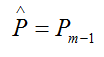
, unde

- preţul imputat, iar

- preţul colectat în luna precedentă.
În continuare propunem un exemplu creat pe date artificiale, ce va elucida impactul generat de modificarea procedurii de reflectare a prețurilor cu caracter puternic sezonier.
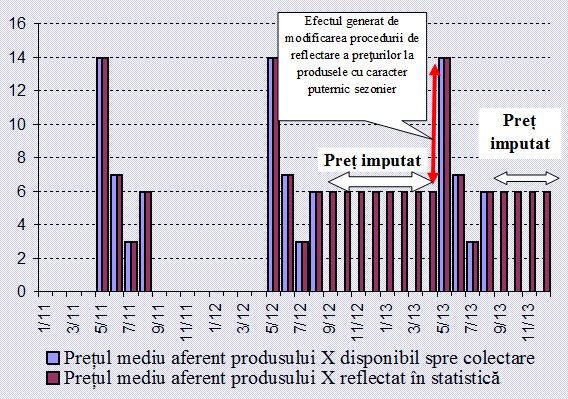
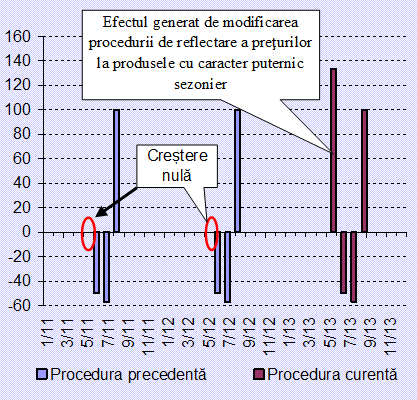
Conform procedurii precedente, odată ce produsul sezonier apărea pe piaţă (luna mai în cazul nostru), BNS îl constata ca produs nou. Prin urmare, nu se calcula ritmul lunar de creştere pentru produsul respectiv, atribuindu-se un ritm nul (graficul nr. 2), ca urmare a inexistenţei unei baze de comparare a preţului din luna precedentă (graficul nr. 1). Totodată, începând cu anul 2013 (odată cu aplicarea noii proceduri) s-a recurs la imputarea preţurilor la produsele cu caracter puternic sezonier pentru lunile în care nu sunt disponibile pentru colectare (graficul nr. 1). Astfel, acest procedeu a şi contribuit la crearea unei baze de comparare pentru luna de apariţie a produselor cu caracter puternic sezonier şi, respectiv, la calcularea ritmului lunar de creştere. Deoarece, preţul imputat este cu mult inferior celui de apariţie, respectiv şi creşterea lunară înregistrată este una pronunţată (graficul nr. 2), ceea ce a şi contribuit la accelerarea ritmului inflaţiei în luna mai. Prin urmare, această creştere nu reprezintă o intensificare a presiunilor inflaţioniste, ci un efect statistic.


