Welcome to the official website of the National Bank of Moldova!
×
Do you have good eyesight and want to turn this tool off?



Welcome to the official website of the National Bank of Moldova!
You can choose one of the most popular reports from the list:

National Bank and the members of its decision-making bodies shall be independent in exercising the tasks conferred upon them by law, and shall neither seek nor take instructions from public authorities or from any other authority.

In order to ensure and maintain price stability over the medium term, the National Bank’s aim will be to keep inflation (measured by Consumer Price Index) at the level of 5.0 percent annually with a possible deviation of ± 1.5 percentage points, considered to be optimal for growth and development of Moldova's economy over the medium-term.

Financial stability is achieved by strengthening the resilience of the financial system, limiting the contagion effect and reducing the accumulation of systemic risks, thus contributing to the sustainability of the financial sector and economic growth.

National Bank shall have the exclusive right to issue on the territory of the Republic of Moldova banknotes and coins as legal tender, as well as commemorative and jubilee banknotes and coins as legal tender and for numismatic purposes.

National Bank is exclusively responsible for the licencing, supervision and regulation of financial institutions activity.

National Bank of Moldova acts as banker and fiscal agent of the State and shall receive from state bodies economic and financial information and documents, which are necessary for carrying out its tasks.
National Bank of Moldova is an autonomous public legal entity and is responsible to the Parliament.

National Bank shall inform the public on the monetary policy strategy on the results of the macroeconomic analysis, the evolution of the financial market and on statistics, including with regard to monetary supply, crediting, balance of payments and the state of the foreign exchange market.

National Bank of Moldova is responsable for the compilation of the balance of payments, international investment position and the statistics of the external debt of the Republic of Moldova.
Raport asupra inflației nr.1, februarie 2013
Transferurile din străinătate efectuate în favoarea persoanelor fiziceConform datelor BNM. reprezintă o sursă semnificativă de finanțare a consumului gospodăriilor populației. În trimestrul III, 2012, conform datelor BNS, ponderea acestora în structura veniturilor disponibile constituia 15.7 la sută. Astfel, transferurile de peste hotare reprezintă un canal important prin intermediul căruia vulnerabilitățile mediului extern sunt transmise economiei Republicii Moldova.
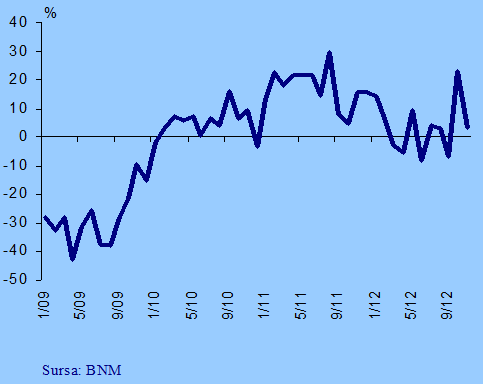
Conform datelor Eurostat, zona euro a intrat oficial în recesiune tehnică, pentru a doua oară în ultimii trei ani, după o contracție economică de 0.1 la sută în trimestrul III, 2012, ce a urmat după un declin de 0.2 la sută înregistrat în trimestrul precedent. Deteriorarea conjuncturii economice în zona euro pe parcursul anului 2012 a avut un impact sesizabil asupra evoluției transferurilor de mijloace bănești efectuate în favoarea persoanelor fizice prin sistemul bancar, care includ și remiterile migranților moldoveni. Astfel, în trimestrele II și III ale anului 2012 ritmul anual al acestora a oscilat în jurul valorii nule după valoarea medie de circa 18.0 la sută înregistrată în anul 2011 (graficul nr. 1).
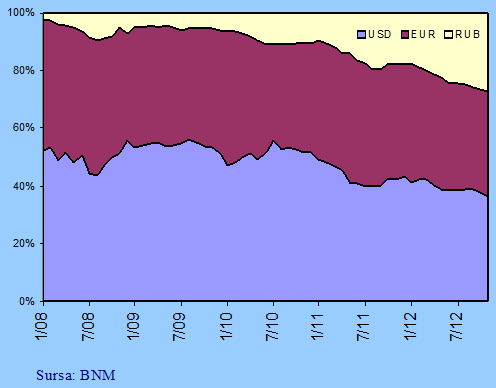
Totodată, se atestă o tendință de diminuare a ponderii transferurilor efectuate în euro și, într-o oarecare măsură, în dolari SUA în favoarea celor efectuate în ruble rusești. Astfel, dacă la sfârșitul anului 2010 transferurile în euro constituiau mai mult de jumătate (51.5 la sută în luna decembrie), cele în dolari SUA - 38.2 la sută, iar cele în ruble ruseşti doar 10.3 la sută, după circa doi ani situația s-a schimbat esențial. În acest fel, către luna noiembrie 2012, ponderea transferurilor în RUB s-a majorat semnificativ, atingând valoarea de 27.3 la sută din total, în detrimentul celor în EUR, care și-au diminuat cota până la valoarea de 36.4 la sută.
În lipsa unei statistici detaliate cu privire la persoanele din afara țării, acest fenomen sugerează o reorientare a migranților moldoveni spre piața muncii din Federația Rusă, în contextul în care economia acesteia a înregistrat o creștere medie de 3.9 la sută de la începutul anului 2012.