Welcome to the official website of the National Bank of Moldova!
×
Do you have good eyesight and want to turn this tool off?



Welcome to the official website of the National Bank of Moldova!
You can choose one of the most popular reports from the list:

National Bank and the members of its decision-making bodies shall be independent in exercising the tasks conferred upon them by law, and shall neither seek nor take instructions from public authorities or from any other authority.

In order to ensure and maintain price stability over the medium term, the National Bank’s aim will be to keep inflation (measured by Consumer Price Index) at the level of 5.0 percent annually with a possible deviation of ± 1.5 percentage points, considered to be optimal for growth and development of Moldova's economy over the medium-term.

Financial stability is achieved by strengthening the resilience of the financial system, limiting the contagion effect and reducing the accumulation of systemic risks, thus contributing to the sustainability of the financial sector and economic growth.

National Bank shall have the exclusive right to issue on the territory of the Republic of Moldova banknotes and coins as legal tender, as well as commemorative and jubilee banknotes and coins as legal tender and for numismatic purposes.

National Bank is exclusively responsible for the licencing, supervision and regulation of financial institutions activity.

National Bank of Moldova acts as banker and fiscal agent of the State and shall receive from state bodies economic and financial information and documents, which are necessary for carrying out its tasks.

National Bank of Moldova is an autonomous public legal entity and is responsible to the Parliament.

National Bank shall inform the public on the monetary policy strategy on the results of the macroeconomic analysis, the evolution of the financial market and on statistics, including with regard to monetary supply, crediting, balance of payments and the state of the foreign exchange market.

National Bank of Moldova is responsable for the compilation of the balance of payments, international investment position and the statistics of the external debt of the Republic of Moldova.
Raport asupra inflației nr.2, mai 2013
Agregatele monetare sunt indicatorii utilizaţi pe larg în cazul analizei monetare care presupune studiul fenomenului de creaţie monetară, dar şi a modificărilor consemnate în structura şi dimensiunea masei monetare cu efectele ulterioare.
Importanţa agregatelor monetare poate fi justificată prin rolul acestora în calitate de:
- indicator statistico-monetar ce permite măsurarea masei monetare şi explicarea modificării acesteia în timp ca urmare a influenţelor de natură economică, politică sau socială, ce acţionează atât pe plan intern, cât şi extern;
- instrument indirect de politică economică pentru atingerea obiectivelor intermediare de politică monetară (regimul de ţintire a agregatelor monetare).
Având în vedere că, structura şi numărul agregatelor monetare sunt diferite de la o ţară la alta, în funcţie de gradul de dezvoltare a pieţei financiare şi de situaţia economică a ţării, sunt necesare criterii comune conform cărora vor fi clasificate aceste agregate. În acest sens, au fost elaborate standarde la nivel internaţional de către organizaţiile internaţionale, precum ar fi Fondul Monetar Internaţional sau Banca Centrală Europeană, în baza cărora se fundamentează metodologia de calcul a agregatelor monetare.
Utilizarea agregatelor monetare presupune definirea conceptuală şi evaluarea cantitativă a acestor indicatori, luând în consideraţie următoarele particularităţi similare agregatelor monetare independent de ţară:
1. caracter progresiv al agregatelor după regula că cel mai mic agregat se conţine în toate celelalte, iar agregatul cel mai mare include toate agregatele mai mici.
2. divizarea acestora conform criteriului lichidităţii, ordinea acestora ne fiind întâmplătoare (spre exemplu, în cazul Republicii Moldova M0 fiind agregatul cu cea mai înaltă lichiditate, iar M3 fiind format din active cu un grad mai redus al lichidităţii).
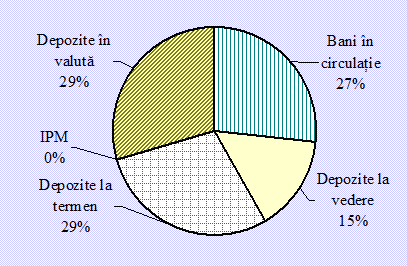
3. sunt indicatori de stoc, care de regulă sunt definiţi la o dată anumită (ex. 31 decembrie 2012, similar graficului nr.1.).
|
Tabelul nr.1: Definirea agregatelor monetare în Republica Moldova |
||||
|
|
M0 |
M1 |
M2 |
M3 |
|
Bani în circulaţie |
X |
X |
X |
X |
|
Depozite la vedere |
|
X |
X |
X |
|
Depozite la termen |
|
|
X |
X |
|
Instrumentele pieţei monetare |
|
|
X |
X |
|
Depozite în valută străină |
|
|
|
X |
Conform metodologiei elaborate de către BNM, structura masei monetare pentru Republica Moldova este reprezentată în tabelul nr.1, fiind formată din 4 agregate monetare (spre exemplu, în Franţa şi Anglia se operează, de asemenea, cu 4 agregate monetare, iar în SUA, acestea sunt în număr de 6).
În cazul Republicii Moldova, pe parcursul anilor 1994-2008 agregatele monetare au servit o bună parte de timp ca obiectiv intermediar pentru politica monetară, perioadă în care obiectivul stabilităţii preţurilor s-a realizat prin intermediul ţintirii agregatelor monetare. Începând cu anul 2009 aceşti indicatori statistico-monetari sunt utilizaţi în analiza economică pentru determinarea din timp a efectelor inflaţioniste.
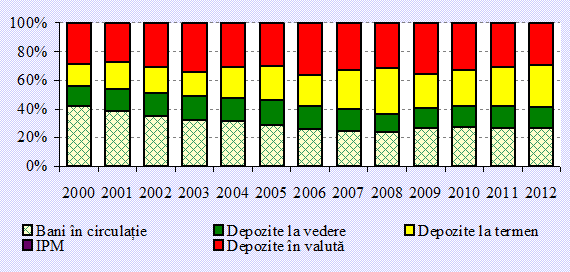
Datele din statistica monetară disponibile la sfârşitul anului 2012 reflectă componenţa agregatului monetar M3 conform graficului nr.1. Cele mai mari ponderi le au depozitele la termen şi cele în valută străină, deţinând câte 29.0 la sută în M3, restul componentelor având ponderi mai mici, banii în circulaţie – 27.0 la sută, iar depozitele la vedere –15.0 la sută. În graficul nr.2. sunt reflectate modificările structurale ale masei monetare pe parcursul anilor 2000-2012. Cele mai semnificative schimbări au survenit în ponderile depozitelor la termen, care au fost în continuă creştere pe parcursul perioadei observabile, de la 15.7 la sută până la 28.9 la sută, concomitent cu diminuarea pronunţată a ponderii banilor în circulaţie de la 41.9 la sută la finele anului 2000 până la 26.7 la sută la 31 decembrie 2012. Reducerea banilor în circulaţie este o consecinţă a dezvoltării segmentului de piaţă pe care sunt tranzacţionaţi banii electronici, iar majorarea ponderii depozitelor la termen denotă încrederea deponenţilor în stabilitatea sistemului financiar bancar al ţării şi dezvoltarea acestui sector în ultimii 10 ani.