Welcome to the official website of the National Bank of Moldova!
×
Do you have good eyesight and want to turn this tool off?



Welcome to the official website of the National Bank of Moldova!
You can choose one of the most popular reports from the list:

National Bank and the members of its decision-making bodies shall be independent in exercising the tasks conferred upon them by law, and shall neither seek nor take instructions from public authorities or from any other authority.

In order to ensure and maintain price stability over the medium term, the National Bank’s aim will be to keep inflation (measured by Consumer Price Index) at the level of 5.0 percent annually with a possible deviation of ± 1.5 percentage points, considered to be optimal for growth and development of Moldova's economy over the medium-term.

Financial stability is achieved by strengthening the resilience of the financial system, limiting the contagion effect and reducing the accumulation of systemic risks, thus contributing to the sustainability of the financial sector and economic growth.

National Bank shall have the exclusive right to issue on the territory of the Republic of Moldova banknotes and coins as legal tender, as well as commemorative and jubilee banknotes and coins as legal tender and for numismatic purposes.

National Bank is exclusively responsible for the licencing, supervision and regulation of financial institutions activity.

National Bank of Moldova acts as banker and fiscal agent of the State and shall receive from state bodies economic and financial information and documents, which are necessary for carrying out its tasks.

National Bank of Moldova is an autonomous public legal entity and is responsible to the Parliament.

National Bank shall inform the public on the monetary policy strategy on the results of the macroeconomic analysis, the evolution of the financial market and on statistics, including with regard to monetary supply, crediting, balance of payments and the state of the foreign exchange market.

National Bank of Moldova is responsable for the compilation of the balance of payments, international investment position and the statistics of the external debt of the Republic of Moldova.
Raport asupra inflației nr.2, mai 2013
Produsul intern brut (PIB) potenţial este definit ca nivelul PIB care nu generează presiuni asupra inflaţiei. Când nivelul PIB efectiv realizat este peste nivelul PIB potenţial, cererea agregată e generatoare de presiuni inflaţioniste, iar răspunsul nivelului agregat al preţurilor se materializează în direcţia creşterii.
Reprezentând măsura excesului de cerere din economie, deviaţia PIB de la nivelul potenţial este relevantă pentru stabilirea conduitei politicii monetare. Pe parcursul orizontului de prognoză politica monetară ancorează inflaţia către ţinta stabilită prin intermediul gestionării cererii agregate.
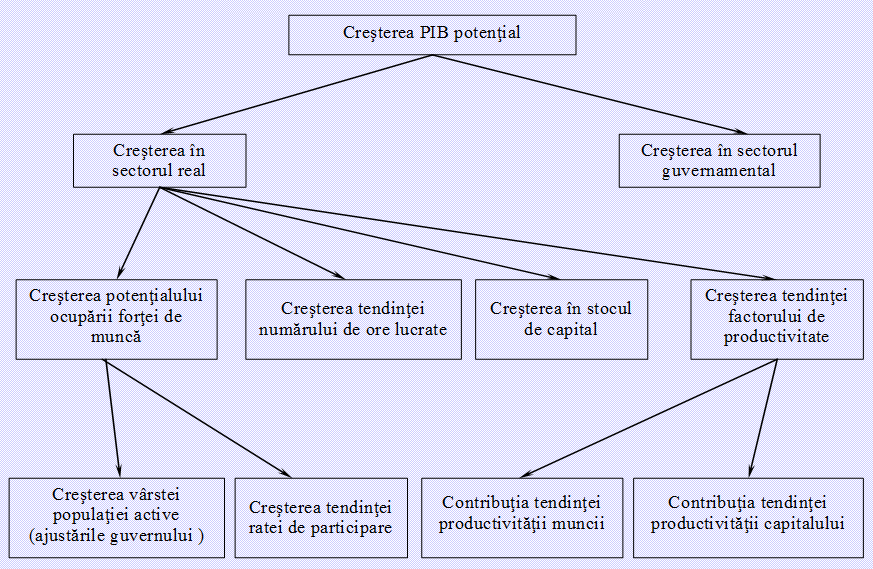
Caracteristicile conceptuale ale noţiunii de PIB potenţial diferă în funcţie de orizontul de timp considerat. Pe termen lung, PIB potenţial este condiţionat, în mare parte, de către caracteristicile structurale din economie. Ritmul de creştere al PIB potenţial este determinat preponderent de factori fundamentali, precum capacitatea productivă, nivelul tehnologic, organizarea economiei, factorii demografici şi educaţionali care condiţionează forţa de muncă etc.
Modificarea acestor factori se produce, de regulă, pe perioade relativ îndelungate, iar efectele sunt semnificative şi durabile. Ritmul de creştere a PIB potenţial corespunde valorilor de echilibru pe termen lung şi numai impactul unor schimbări sau şocuri de proporţie sau structurale pot avea un impact considerabil. Printre factorii ce pot avea un impact negativ asupra modificării PIB potenţial se numără: îmbătrânirea bruscă a populaţiei, casarea din stocurile de capital existent din cauza eşecurilor în afaceri, volumul mic de investiţii interne şi externe, efectul descurajator asupra forţei de muncă, precum şi şocurile negative asupra productivităţii.
Pe termen mediu, ritmul de creştere a PIB potenţial poate avea abateri de la valoarea sa de echilibru pe termen lung, către care tinde să revină după epuizarea efectelor unor factori cu acţiune temporară. Printre factorii care afectează pe termen mediu ritmul de creştere a PIB potenţial sunt influxurile de investiţii străine directe, migraţia temporară a forţei de muncă, variaţia potenţialului agriculturii şi impactul factorilor meteorologici.
PIB potenţial nu este un indicator direct observabil. Din această cauză determinarea acestuia este o problemă dificilă, mai cu seamă în cazul unei economii emergente aflată în proces de transformare structurală asemenea economiei Republicii Moldova. Determinarea PIB potenţial se realizează indirect, în baza informaţiilor oferite de evoluţia unor variabile macroeconomice observabile, precum PIB efectiv, inflaţia, rata dobânzii, cursul de schimb, rata şomajului etc. Ca urmare, orice estimare a PIB potenţial este însoţită de o anumită incertitudine.


