Welcome to the official website of the National Bank of Moldova!
×
Do you have good eyesight and want to turn this tool off?



Welcome to the official website of the National Bank of Moldova!
You can choose one of the most popular reports from the list:

National Bank and the members of its decision-making bodies shall be independent in exercising the tasks conferred upon them by law, and shall neither seek nor take instructions from public authorities or from any other authority.
In order to ensure and maintain price stability over the medium term, the National Bank’s aim will be to keep inflation (measured by Consumer Price Index) at the level of 5.0 percent annually with a possible deviation of ± 1.5 percentage points, considered to be optimal for growth and development of Moldova's economy over the medium-term.

Financial stability is achieved by strengthening the resilience of the financial system, limiting the contagion effect and reducing the accumulation of systemic risks, thus contributing to the sustainability of the financial sector and economic growth.
National Bank shall have the exclusive right to issue on the territory of the Republic of Moldova banknotes and coins as legal tender, as well as commemorative and jubilee banknotes and coins as legal tender and for numismatic purposes.

National Bank is exclusively responsible for the licencing, supervision and regulation of financial institutions activity.
National Bank of Moldova acts as banker and fiscal agent of the State and shall receive from state bodies economic and financial information and documents, which are necessary for carrying out its tasks.

National Bank of Moldova is an autonomous public legal entity and is responsible to the Parliament.

National Bank shall inform the public on the monetary policy strategy on the results of the macroeconomic analysis, the evolution of the financial market and on statistics, including with regard to monetary supply, crediting, balance of payments and the state of the foreign exchange market.

National Bank of Moldova is responsable for the compilation of the balance of payments, international investment position and the statistics of the external debt of the Republic of Moldova.
Raport asupra inflației nr.2, mai 2013
Ca urmare a lipsei resurselor semnificative de petrol şi a rafinăriilor pe teritoriul Republicii Moldova, economia naţională este dependentă de importurile de derivate petroliere şi, respectiv, fluctuaţiile preţurilor internaţionale la petrol influenţează esenţial atât evoluţia preţurilor, cât şi ritmul activităţii economiei naţionale. Majorarea preţurilor la materiile prime pe piaţa mondială duce la scumpirea factorilor de producţie proveniţi din import şi a bunurilor şi serviciilor obţinute pe seama factorilor de producţie importaţi, pierderea sau restrângerea unor pieţe de desfacere. Acest fapt determină majorarea costului mediu fix, atragerea în circuitul economic a unor factori de producţie mai rar utilizați, noi sau calitativi, ale căror preţuri sunt superioare în raport cu valoarea productivităţii marginale, ca urmare a alocării ineficiente a resurselor, precum şi la majorarea impozitelor, taxelor, chiriilor etc. soldate cu majorarea costurilor unitare ca rezultat al politicilor guvernamentale. Aceste efecte poartă denumirea de efecte de runda a doua.
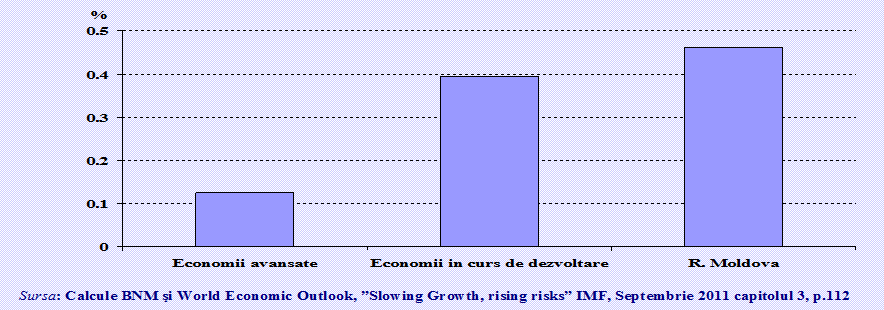
Efectele de runda a doua asupra inflaţiei de bază sunt propagate şi de creşterea bruscă a preţurilor la produselor alimentare pe pieţele internaţionale, reflectate pe piaţa internă prin preţurile produselor alimentare şi prin prisma costului importurilor. Conform estimărilor Fondului Monetar Internaţional, în lucrarea ”Slowing Growth, rising risks” [1], acest impact este mai mare în ţările în curs de dezvoltare decât în cele cu economii avansate, ca urmare a ponderii mai mari a produselor alimentare şi a unei ancorări reduse a aşteptărilor inflaţioniste. În cazul Republicii Moldova, coeficienţii estimaţi, în baza unui model de autoregresie vectorială, sunt similari celor din economiile în curs de dezvoltare, şi anume impactul cumulat (până la stabilizarea sistemului) al unui şoc de 1.0 la sută la preţurile produselor alimentare asupra IPC total este de 0.46 la sută,2 în timp ce în ţările în curs de dezvoltare, acesta abia atinge valoarea 0.39.
În cazul creşterii preţurilor la combustibili, efectul asupra creşterii inflaţiei de bază este semnificativ. O creştere de 1.0 la sută va avea un impact cumulativ asupra inflaţiei de bază pe termen mediu de 0.33 la sută, preţurile la produsele alimentare fiind afectate şi ele de o creştere de 0.50 puncte procentuale.
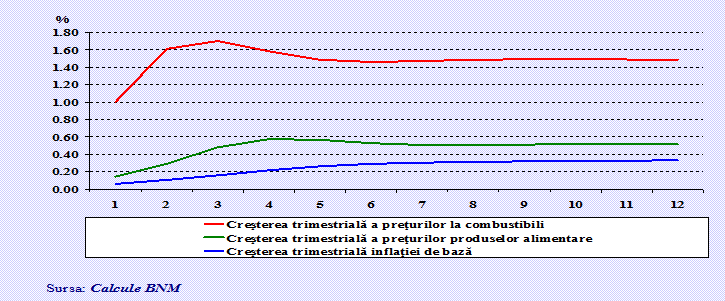
Estimările efectelor de runda a doua ca urmare a creşterii preţurilor la petrol, precum şi a preţurilor produselor alimentare pe pieţele internaţionale asupra inflaţiei de bază sunt distorsionate ca rezultat al efectelor variabilelor intermediare (în special, rata nominală efectivă de schimb şi agregatele monetare). Aprecierea ratei nominale efective de schimb, pe de o parte, ar reduce presiunile inflaţioniste pe termen scurt, iar pe de altă parte, această apreciere poate eroda competitivitatea externă a economiei, amplificând astfel dezechilibrele externe. Dezechilibrele externe mari sporesc vulnerabilitatea economiei la modificarea percepţiei investitorilor sau la şocurile asociate volatilităţii înalte de pe pieţele externe, ceea ce conduce la deprecierea monedei şi, în cele din urmă, la o inflaţie mai mare.
Într-un cadru de interdependenţă financiară globală şi de incertitudine sporită, politica monetară cu regim de ţintire directă a inflaţiei este caracterizată prin angajament, consistenţă dinamică, transparenţă, asumare a responsabilităţii, evaluare calitativă, evitare a fluctuaţiilor excesive şi flexibilitate, set de atribute care implică, în mod inevitabil, complexitate. Astfel, determinarea şi cuantificarea efectelor de runda a doua asupra inflaţiei de bază este esenţială. Prin atenuarea acestor efecte temporare, inflaţia de bază rămâne a fi partea inflaţiei ce permite perceperea trendului şi reflectarea surselor persistente ale presiunilor inflaţioniste.
[1] World Economic Outlook, ”Slowing Growth, rising risks” IMF, Septembrie 2011 capitolul 3, p.112
[2] Institutul de Economie, Finanţe şi Statistică, “Economie şi Sociologie”, Ed. II. 2012, p. 130


