Welcome to the official website of the National Bank of Moldova!
×
Do you have good eyesight and want to turn this tool off?



Welcome to the official website of the National Bank of Moldova!
You can choose one of the most popular reports from the list:

National Bank and the members of its decision-making bodies shall be independent in exercising the tasks conferred upon them by law, and shall neither seek nor take instructions from public authorities or from any other authority.

In order to ensure and maintain price stability over the medium term, the National Bank’s aim will be to keep inflation (measured by Consumer Price Index) at the level of 5.0 percent annually with a possible deviation of ± 1.5 percentage points, considered to be optimal for growth and development of Moldova's economy over the medium-term.

Financial stability is achieved by strengthening the resilience of the financial system, limiting the contagion effect and reducing the accumulation of systemic risks, thus contributing to the sustainability of the financial sector and economic growth.

National Bank shall have the exclusive right to issue on the territory of the Republic of Moldova banknotes and coins as legal tender, as well as commemorative and jubilee banknotes and coins as legal tender and for numismatic purposes.

National Bank is exclusively responsible for the licencing, supervision and regulation of financial institutions activity.

National Bank of Moldova acts as banker and fiscal agent of the State and shall receive from state bodies economic and financial information and documents, which are necessary for carrying out its tasks.
National Bank of Moldova is an autonomous public legal entity and is responsible to the Parliament.

National Bank shall inform the public on the monetary policy strategy on the results of the macroeconomic analysis, the evolution of the financial market and on statistics, including with regard to monetary supply, crediting, balance of payments and the state of the foreign exchange market.

National Bank of Moldova is responsable for the compilation of the balance of payments, international investment position and the statistics of the external debt of the Republic of Moldova.
Raport asupra inflației nr.2, mai 2013
La aprecierea nivelului dobânzii un rol deosebit se acordă atât sub aspect teoretic cât şi practic curbelor de randament.
Curba de randament este o curbă continuă, care descrie relaţia funcţională între randamentul la data scadenţei şi numărul de ani ce intervin înaintea scadenţei, pentru titlurile cu venit fix, la un moment dat.
Sunt cuprinse şi reprezentate, de asemenea, creanţe egale din alte puncte de vedere: risc de rambursare, lichiditate, preţ de achiziţie etc. Deşi se rezumă numai la anumite creanţe, curbele de randament sunt semnificative pentru întreaga piaţă a creditului.
În SUA obiectul unei astfel de reprezentări îl constituie bonurile de tezaur, în Republica Moldova – valorile mobiliare de stat.
Potrivit conjuncturii de moment, curbele de randament pot avea trei modalităţi de expresie:
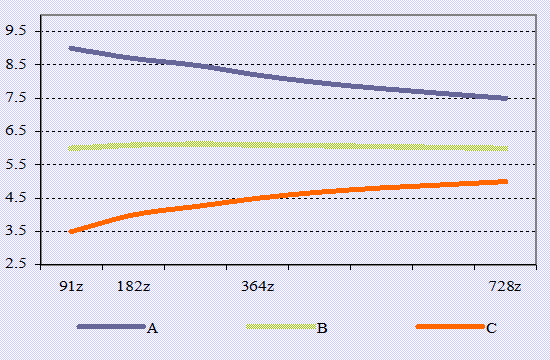
Curba plată subliniază că randamentele titlurilor pe termen scurt, mediu şi lung sunt practic aceleaşi şi, deci, raporturile dintre cerere şi ofertă sunt echilibrate pe ansamblul pieţei (graficul nr.1, curba B).
Curba orientată în sus relevă că titlurile pe termen lung au un randament ridicat şi sugerează că cererea de fonduri pe termen scurt este foarte puternică (în raport cu oferta) faţă de cererea de fonduri pe termen lung (graficul nr.1, curba C).
Curba orientată în jos exprimă că titlurile pe termen scurt au un randament foarte ridicat, ceea ce înseamnă că cererea de fonduri pe termen lung este foarte puternică (în raport cu oferta) faţă de cererea de fonduri pe termen scurt (graficul nr.1, curba A).
Pentru explicaţia configuraţiilor curbei de randament au fost înaintate trei ipoteze:
În Republica Moldova (graficul nr.2) curba randamentelor VMS are o formă convexă, ceea ce indică că randamentele la aceste maturităţi sunt mai mari. Acest fenomen are loc datorită faptului, că piaţa valorilor mobiliare de stat este segmentată conform preferinţelor investitorilor. Majoritatea acestora fiind băncile licenţiate, preferă să investească în VMS cu scadenţa mai mică, care se consideră a fi mai lichide, însă şi oferta din partea Ministerului Finanţelor este orientată în mare parte spre bonurile de trezorerie. De regulă, la o licitaţie pe lună, băncile licenţiate procură şi obligaţiuni de stat cu scadenţa de 2 ani, însă atât oferta din partea Ministerului Finanţelor, cât şi cererea sunt mult mai mici decât la bonurile de trezorerie. Astfel, piaţa este segmentată în felul următor: primul segment – bonurile de trezorerie de la 91 de zile până la 364 de zile şi al doilea segment îl constituie obligaţiunile de stat de 2 ani. Volumul tranzacţionat pe aceste segmente diferă, pe primul segment se tranzacţionează circa 99.0 la sută din totalul tranzacţiilor pe piaţa valorilor mobiliare, atunci când volumul tranzacţionat cu obligaţiuni de stat cu termenul de 2 ani constituie circa 1.0 la sută din total. În plus, ratele dobânzii la obligaţiunile de 2 ani pot fi explicate prin ipoteza anticipaţiilor. Cel mai probabil referitor la acest tip de VMS investitorii se aşteaptă la o diminuare a dobânzii, precum şi a ratei inflaţiei.