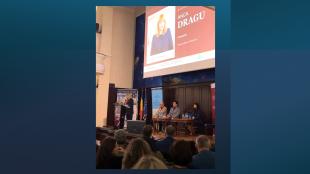
Bine ați venit pe pagină oficială a Băncii Naționale a Moldovei!



Bine ați venit pe pagină oficială a Băncii Naționale a Moldovei!
Cele mai populare rapoarte statistice:
Banca Naţională şi membrii organelor de conducere ale acesteia sunt independenţi în exercitarea atribuţiilor stabilite de lege şi nu pot solicita şi nici accepta instrucţiuni de la autorităţile publice sau de la orice altă autoritate.



Banca Naţională informează publicul despre evoluția inflației anuale, strategia de politică monetară,rezultatele analizei macroeconomice, evoluţiei pieţei financiare şi informaţia statistică, inclusiv privind masa monetară, acordarea creditelor, balanţa de plăţi şi situaţia pieţei valutare.
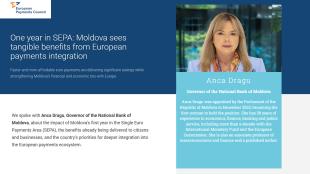


Pentru asigurarea şi menţinerea stabilităţii preţurilor pe termen mediu, Banca Naţională a Moldovei menţine inflaţia (măsurată prin indicele preţurilor de consum) la nivelul de 5.0 la sută anual cu o posibilă abatere de ± 1.5 puncte procentuale, fiind considerat nivelul optim pentru creşterea şi dezvoltarea economică a Republicii Moldova pe termen mediu.




Stabilitatea financiară se realizează prin consolidarea rezilienței sistemului financiar, limitarea efectului de contagiune și diminuarea acumulării de riscuri sistemice, contribuind, astfel, la sustenabilitatea sectorului financiar și creșterea economică.



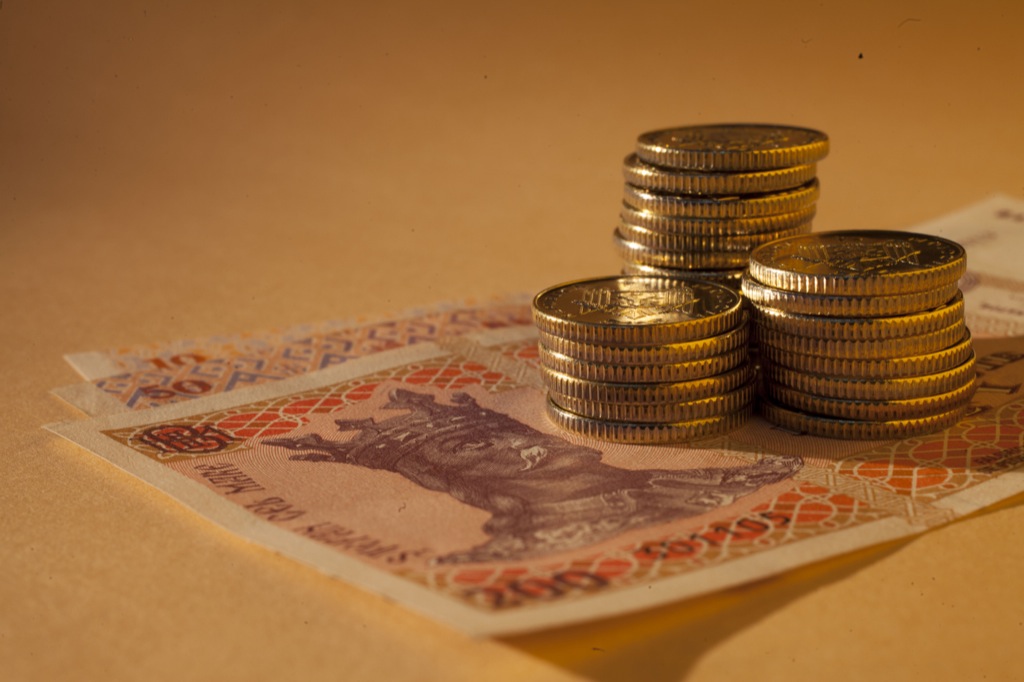
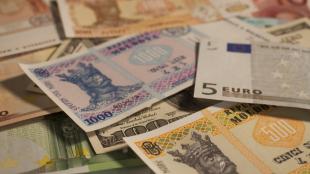
Banca Naţională a Moldovei, are dreptul exclusiv de a emite pe teritoriul Republicii Moldova bancnote şi monede metalice ca mijloc de plată. BNM pune în circulaţie bancnote şi monede metalice, prin intermediul sistemului bancar.




Banca Naţională este unica instituţie care efectuează licenţierea, supravegherea şi reglementarea activităţii instituţiilor financiare.



Banca Națională supraveghează sistemul de plăţi în Republica Moldova şi promovează funcţionarea stabilă şi eficientă a sistemului automatizat de plăţi interbancare.


Banca Naţională este o persoană juridică publică autonomă şi este responsabilă faţă de Parlament.

BNM publică statistici privind masa monetară, sectorul bancar, balanța de plăți, situația pieței valutare, etc. pentru a asigura transparența în procesul de elaborare și adoptare a deciziilor BNM, a asigura continuitatea în comunicare și predictibilitatea BNM pe piață, pentru sporirea credibilității BNM în calitate de bancă centrală dar și pe piața financiar-bancară din Republica Moldova.


In 2016, the world economy was rich in events, which established new macroeconomic trends at the international level. The macroeconomic policies in the advanced economies, concentrated on consumption stimulation, had a beneficial effect over these economies and most of emerging and developing economies, which recovered following the external demand growth and high international prices of raw materials. An important event in oil market was the signing by OPEC countries of the agreement on oil volume production decrease on 30 November 2016. This agreement was the main factor of oil prices recovery up to the value of USD 50 per barrel at the end of 2016, after which, the price per barrel reached in January 2016 the lowest level since 2004. The significant volatility of foreign exchange markets represented another important aspect in the world economy. The USD appreciation trend was driven by the Federal Reserve System policy to interconnect the interest rates range to the positive trends of the U.S. economy development. Also, Pound sterling depreciated significantly due to the results of the United Kingdom European Union membership referendum and further forecasts of Brexit consequences.
In 2016, the economy of the Republic of Moldova recorded an increase of 4.1 percent after the slight negative dynamics of 2015. In the first half of 2016, GDP recorded an annual modest dynamic after the drought of 2015 and due to the non-favourable regional economic climate conditions, an economic uncertainty and internal policy, which generated an insignificant domestic demand and the investment decrease. The economic growth was more pronounced in the second half of the year, due mainly to the favourable meteorological conditions during 2016 that determined a high performance in agricultural sector. Thus, the negative dynamic in 2015 was caused by the drought, in 2016 the gross value added recorded positive developments in agriculture and in the connected sectors such as: manufacturing industry, trade and transports. At the same time, the constructions sector recorded a negative dynamic. In 2016, the positive evolution of agricultural sector favoured the increase in exports and household consumption compared to 2015. Also, the final consumption of public administration and the gross fixed capital recorded a negative dynamic compared to 2015. The evolution of the change in inventories subcomponent generated a negative impact on GDP dynamics in 2016. In 2016, the economic activity dynamics was significantly offset by the increase of imports compared to 2015.
During 2016, the annual inflation rate recorded a pronounced downward trajectory, decreasing from 13.6 percent in December 2015 to 2.4 percent in December 2016. In August, this fell within the range of 5.0 percent ±1.5 percentage points stipulated in the Medium-term monetary policy strategy, accounting for 3.6 percent. Thereafter, the annual inflation rate continued its downward trend, being below the lower limit of the target range mentioned above. The average annual inflation rate in 2016 was 6.4 percent and was significantly lower than 2015. The inflation downward evolution was due mainly to the modest domestic demand, higher level of base period in 2015 and to a rich harvest that favoured the decrease in food prices. At the same time, the downward trajectory of inflation was also determined by the diminution of pressures from regulated prices, as a result of the downward adjustment of gas and electricity tariffs in the first half of the year and following the gradual dissipation of the impact of the electricity tariff increase in summer of 2015. The evolution of national currency against the U.S. dollar and the upward trajectory of food and oil prices on international market offset partially the disinflationary influence of the aforementioned factors.
During 2016, there were held twelve meetings of the Executive Board of the National Bank on Moldova on monetary policy decisions. Following the assessment of the balance of internal and external risks, which could be faced by the Moldovan economy and inflation forecasts on medium term, there were adopted five decisions to maintain and seven decisions to decrease the base rate applied to main monetary policy operations from the level of 19.5 percent to 9.0 percent annually.
The required reserves ratio from financial means attracted in MDL and non-convertible currency was maintained at the level of 35.0 percent of the base during 2016. At the same time, the minimum required reserve ratio attracted in freely convertible currency were maintained at the level of 14.0 percent during 2016.
The monetary indicators recorded an upward trend in 2016. Thus, the dynamic of monetary aggregates was positive, the values registered in annual terms were 18.3 percent for M2 (by 27.4 percentage points more than in 2015) and 10.2 percent for M3 (by 13.2 percentage points lower than in 2015).
During reporting period, the average annual interest rate on new loans in national currency increased by 0.14 percentage points, while the average annual interest rate on new loans in foreign currency decreased by 1.11 percentage points compared to 2015, recording values of 14.20 percent in national currency and 5.90 percent in foreign currency. The average interest rate on deposits in MDL accounted for 10.71 percent, decreasing by 1.39 percentage points compared to 2015, while the interest rate on placements in foreign currency constituted on average 2.12 percent, decreasing by 0.44 percentage points compared to 2015.
As at 31 December 2016, the banking sector of the Republic of Moldova included 11 banks licensed by the National Bank of Moldova, of which 4 are branches of foreign banks and financial groups.
However, two banks (B.C. „VICTORIABANK” S.A. and BC „MOLDOVA-AGROINDBANK” S.A.) were under intensive supervision. Intensive supervision (substituted the special supervision, taking into account the amendments to legislation) is maintained due to the detection of issues related to non-transparent shareholders' structure, banks engaged in high risk lending operations and the unsolving of these issues.
As from 20 October 2016, BC „Moldindconbank” S.A is supervised within the early intervention regime, as a result of the fact that a group of persons acquired and held a qualifying holdings in the bank's share capital, in the amount of 63.89 percent, without prior written permission of the NBM, thereby infringing the provisions of the Law on financial institutions.
It should be mentioned that after the application of the early intervention regime, the liquidity situation of BC „Moldindconbank” S.A. remained stable, without significant withdrawals of deposits as anticipated.
The total number of licensed banks subdivisions was 804, of which 288 branches and 516 agencies. As of 31 December 2016, the total number of staff employed in the banking sector amounted to 7 868 employees.
Tier I capital of the banking system reached the level of MDL 9 437.8 million, increasing by MDL 429.6 million compared to the end of 2015 (4.8 percent).
The average of risk-weighted capital adequacy indicator of the sector recorded the value of 30.1 percent, increasing by 3.8 percentage points compared to the end of 2015. As of 31 December 2016, all banks have observed the risk-weighted capital adequacy indicator (the limit for each bank ≥ 16 percent).
The total assets of the sector were MDL 72 951.4 million, increasing by MDL 4 161.2 million (6.0 percent) compared with the end of 2015.
Gross loans portfolio was MDL 34 761.3 million, decreasing by MDL 3 425.3 million (9.0 percent) during 2016. The decrease of gross loans portfolio was determined mainly by the lack of loan demand and a more cautious approach applied by banks against potential debtors.
The non-performing loans (substandard, doubtful, and compromised) increased in absolute value by MDL 1 871.3 million (49.3 percent), amounting to MDL 5 669.9 million, while the share of non-performing loans in total loans increased by 6.4 percentage points compared to the end of 2015, accounting for 16.3 percent as of 31 December 2016. The share of net non-performing loans in total regulatory capital increased by 4.5 percentage points, amounting to 19.5 percent as at 31 December 2016.
As at 31 December 2016, the profit of the banking sector accounted for MDL 1 466.7 million and all banks recorded profit. The profit increased by MDL 322.5 million (28.2 percent) compared to the end of 2015.
In 2016, the rentability of assets and capital of licensed banks recorded the value of 2.0 percent and 11.9 percent, respectively, increasing by 0.3 percentage points and 1.8 percentage points, respectively, compared to the end of 2015.
Net interest margin was 5.5 percent as at 31 December 2016, remaining at the level of 2015.


