
Bine ați venit pe pagină oficială a Băncii Naționale a Moldovei!



Bine ați venit pe pagină oficială a Băncii Naționale a Moldovei!
Cele mai populare rapoarte statistice:

Banca Naţională şi membrii organelor de conducere ale acesteia sunt independenţi în exercitarea atribuţiilor stabilite de lege şi nu pot solicita şi nici accepta instrucţiuni de la autorităţile publice sau de la orice altă autoritate.



Banca Naţională informează publicul despre evoluția inflației anuale, strategia de politică monetară,rezultatele analizei macroeconomice, evoluţiei pieţei financiare şi informaţia statistică, inclusiv privind masa monetară, acordarea creditelor, balanţa de plăţi şi situaţia pieţei valutare.

Pentru asigurarea şi menţinerea stabilităţii preţurilor pe termen mediu, Banca Naţională a Moldovei menţine inflaţia (măsurată prin indicele preţurilor de consum) la nivelul de 5.0 la sută anual cu o posibilă abatere de ± 1.5 puncte procentuale, fiind considerat nivelul optim pentru creşterea şi dezvoltarea economică a Republicii Moldova pe termen mediu.




Stabilitatea financiară se realizează prin consolidarea rezilienței sistemului financiar, limitarea efectului de contagiune și diminuarea acumulării de riscuri sistemice, contribuind, astfel, la sustenabilitatea sectorului financiar și creșterea economică.




Banca Naţională a Moldovei, are dreptul exclusiv de a emite pe teritoriul Republicii Moldova bancnote şi monede metalice ca mijloc de plată. BNM pune în circulaţie bancnote şi monede metalice, prin intermediul sistemului bancar.




Banca Naţională este unica instituţie care efectuează licenţierea, supravegherea şi reglementarea activităţii instituţiilor financiare.



Banca Națională supraveghează sistemul de plăţi în Republica Moldova şi promovează funcţionarea stabilă şi eficientă a sistemului automatizat de plăţi interbancare.



Banca Naţională este o persoană juridică publică autonomă şi este responsabilă faţă de Parlament.

BNM publică statistici privind masa monetară, sectorul bancar, balanța de plăți, situația pieței valutare, etc. pentru a asigura transparența în procesul de elaborare și adoptare a deciziilor BNM, a asigura continuitatea în comunicare și predictibilitatea BNM pe piață, pentru sporirea credibilității BNM în calitate de bancă centrală dar și pe piața financiar-bancară din Republica Moldova.


During the first semester of 2022, the National Bank of Moldova (NBM) continued the process of prudential supervision of banks in the Republic of Moldova, pursuing compliance with legal requirements, to ensure the stability and viability of the banking system.
The banking sector, in the first semester of 2022, according to the data presented by the banks, was characterized by a high level of liquidity and increased assets, loans, own funds, and bank deposits. The profit of the financial year compared to the similar period of the previous year has increased, mainly because of the increase in interest and non-interest income.
At the same time, the volume of deposits of individuals and legal entities decreased as a result of withdrawals made in the first part of the year. There was also an increase in the absolute value of expired and non-performing loans and, as a result, a slight worsening of the quality indicators of the loan portfolio compared to the end of the previous year.
As of June 30, 2012, 11 banks licensed by the National Bank of Moldova were active in the Republic of Moldova. One bank was supervised under the early intervention regime applied on 11.01.2019. Following that, the NBM Executive Committee decided to extend the term of appointment of the temporary administrators until October 28, 2022. Currently, following the changes registered in the bank’s shareholding structure, the management bodies are being completed.
Financial situation of the banking sector and compliance with prudential regulations
On June 30, 2022, the situation in the banking sector, as reflected in the reports submitted by banks, registered the following trends:
Assets and liabilities
Total assets amounted to MDL 120.4 billion, increasing during the first semester of 2022 by 1.6% (MDL 1.9 billion).
In the structure of assets, the largest share belonged to the item in the balance sheet “Loans and advances at amortized cost”, which constituted 48.6% (MDL 58.6 billion), increasing by 2.5 percentage points compared to the end of the previous year.
The share of funds at the NBM was 23.4% (MDL 28.2 billion), increasing by 4.5 percentage points, and the share of banks’ investments in state securities and in the certificates of the National Bank of Moldova constituted 11.9% (MDL 14.3 billion), decreasing by 4.0 percentage points. The rest of the assets, which constitute 16.0% (MDL 19.3 billion), are maintained by banks in other banks, in cash, tangible fixed assets, intangible fixed assets, etc. Their share decreased by 2.8 percentage points.
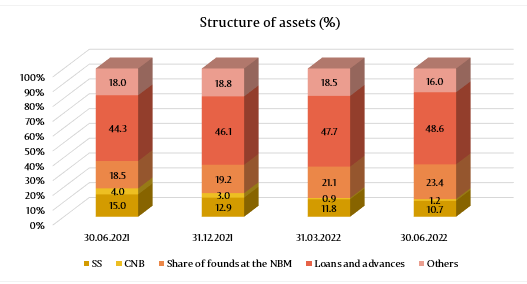
The gross (prudential) loan balance constituted 50.0% of total assets, or 60.2 billion lei, increasing by 6.8% (3.8 billion lei) during the examined period. At the same time, the volume of new loans granted during the first semester of 2022 increased by 1.3% compared to the same period of the previous year.
The largest increase during the first semester of 2022 was recorded in loans granted for the purchase or construction of real estate, whose balance increased by 1.0 billion lei (9.0%), up to 12.5 billion lei, loans granted for the non-banking financial sector – by 591.4 million lei (32.8%), up to 2.4 billion lei; loans granted to individuals performing an activity – by 461.0 million lei (40.2%), up to 1.6 billion lei; loans granted to trade – by 313.9 million lei (2.6%), up to 12.5 billion lei; and for consumer loans – by 313.8 million lei (3.0%), up to 10.8 billion lei.
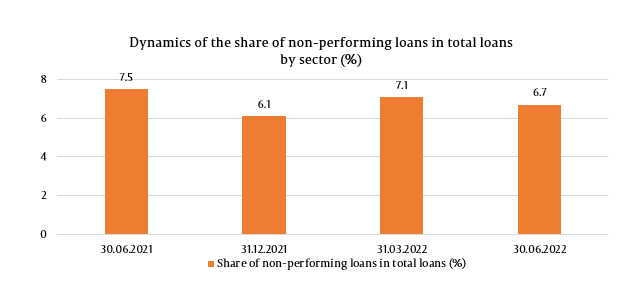
During the reference period, the share of non-performing loans (substandard, doubtful, and compromised) in total loans increased by 0.6 percentage points, accounting for 6.7% on June 30, 2022, the mentioned indicator ranging from 2.0% to 10.7%, depending on the bank.
At the same time, non-performing loans' absolute value increased by 17.1% (590.1 million lei), amounting to 4.1 billion lei.
The amount of expired loans increased by 6.8% (118.4 million lei) during the examined period, reaching 1.9 billion lei. The share of expired loans in total loans was 3.1%, the same as on December 31, 2021, ranging from 0.8% to 10.0% depending on the bank.
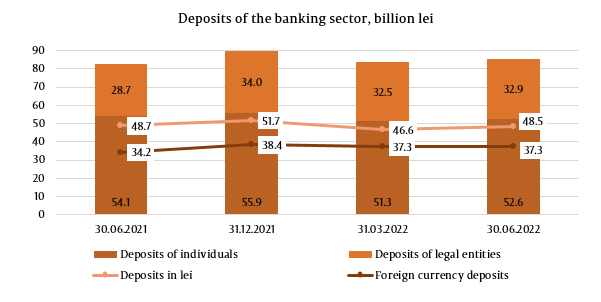
At the same time, during the reference period, there was a decrease in the balance of deposits, triggered mainly by external events. According to prudential reports, it decreased by 4.3 billion lei or by 4.8%, amounting to 85.8 billion lei (deposits of individuals accounting for 61.3% of total deposits, deposits of legal entities – 38.4%, and bank deposits – 0.3%) as a result of the decrease in the balance of deposits of individuals by 3.4 billion lei (6.0%), up to 52.6 billion lei, and deposits of legal entities by 1.1 billion lei (3.2%), up to 32.9 billion lei. At the same time, bank deposits increased by 150.4 million lei (101.6%), up to 298.5 million lei.
In total deposits, 56.5% returned to deposits in lei, their balance decreasing by 3.2 billion lei (6.2%) compared to the end of the previous year and amounted to 48.5 billion lei on 30.06.2022. Foreign currency deposits accounted for 43.5% of total deposits; their balance decreased during the reference period by 1.1 billion lei (2.8%), amounting to 37.3 billion lei (withdrawal of foreign currency deposits – the equivalent of 1.9 billion lei; positive revaluation of foreign currency deposits – 829.1 million lei).
Revenues and profitability
On June 30, 2022, the profit in the banking system amounted to 1.6 billion lei, increasing by 80.4% (726.0 million lei) compared to the similar period of the previous year.
The increase in profit was determined by the increase in interest income by 1.4 billion lei (60.9%) (mainly from lending activity), income from exchange rate differences – by 249,8 million lei (47.9%), and income from fees and commissions by 243.8 million lei (21.1%). Non-interest expenses (fees and commissions, administrative expenses, provisions, impairment of financial and non-financial assets, and so on) increased by 941.2 million lei (36.7%), while interest expenses increased by 252.2 million lei (42.1%).
Total revenues amounted to 6.0 billion lei, increasing by 1.9 billion lei (42.7%) compared to the same period of the previous year, of which interest income accounted to 3.7 billion lei (62.4%) and non-interest income – 2.2 billion lei (37.6%).
At the same time, total expenditures amounted to 4.4 billion lei, increasing by 1.2 billion lei (37.7%) compared to the same period of the previous year, of which interest expenses constituted 851.5 million lei (19.5%) of the total expenses and non-interest expenses – 3.5 million lei (80.5%) of the total expenses.
On June 30, 2022, assets and capital rentability accounted for 2.7% and 15.9%, respectively, increasing by 0.7 and 3.7% percentage points compared to the end of the previous year.
Compliance with prudential requirements
During the first semester of 2022, banks continued to maintain their liquidity indicators at a high level, beyond the regulated limits.
Thus, the value of the long-term liquidity indicator (liquidity principle I) was 0.74 (≤1 limit), ranging from 0.33 to 0.89, depending on the bank, and being practically at the same level as at the end of 2021.
Liquidity principle III, which represents the ratio between the adjusted actual liquidity and the required liquidity on each maturity band and which must not be less than 1 on each maturity band, has also been respected by all banks, ranging from 1.54, on the maturity band up to one month inclusive, to 95.2, on the maturity band between 6 and 12 months inclusive.
The liquidity coverage indicator by sector amounted to 223.7% (limit ≥80% - as of January 1, 2022), ranging from 139.2% to 519.3%, decreasing by 134.6 percentage points compared to the end of the previous year.
According to bank reports as of June 30, 2022, the ratio of total own funds in the banking sector stood at 29.3%, up 3.4 percentage points from the end of the previous year, and ranged between 22.1% and 63.4%. The indicator "total equity rate" (10%) was met by all banks.
Also, all banks complied with the requirements of the “Total equity rate” indicator, considering the capital buffers.
As of 30.06.2022, total own funds constituted 17.7 billion lei and registered an increase of 16.3% (2.5 billion lei). The increase in own funds was mainly determined by the reflection by the banks of the eligible profits after the holding of the general meetings of the shareholders and after obtaining the NBM's permission regarding the inclusion in the own funds of the profits made in 2021.
As of June 30, 2022, banks complied with prudential indicators regarding large exposures and exposures to their related parties.
Development of the national legislative framework and its harmonization with EU legislation
During the second quarter of 2022, in order to apply the provisions of Law No. 202/2017 on the activity of banks, a number of amendments have been carried out:
- The new edition of the Regulation on qualified holdings of banks has been approved, which includes provisions regarding qualified holdings of banks in the capital of companies, including the accepted limits for these holdings, and specifies a list of companies in the capital of which the bank may own qualified holdings, including exercising control over the company, as well as the procedure for obtaining prior approval issued by the NBM for qualified holdings;
- It has been approved the new edition of the Regulation on banks’ investments in real estate (in force July 15, 2022), which aims to implement the provisions of Law 202/2017 on the activity of banks and align the terminology with the Basel III framework and the International Financial Reporting Standards;
- Regulation No. 240/2013 on banks’ transactions with their related parties has been amended, aiming to revise certain provisions in order to remove deficiencies in the application and interpretation of the provisions of the Regulation within the bank's relations with their clients – related parties. Thus, the list of transactions with the related parties has been revised and completed in order to exclude those that will not be considered transactions with the related parties because, according to their nature, they represent intermediary services provided by banks and/or are transactions/operations resulting from transactions/contractual obligations concluded with related parties.
At the same time, the cumulation of the transaction value of the related party with the bank (which forms the exposure) with the value of the transactions of customers connected with the related parties with the bank was included, with the aim of determining the threshold in the process of approving the transaction, starting from the fact that such connections lead to the assumption of a common risk.
Also, the rules that provide for the exemptions from the prior approval of transactions with related parties by the bank's management bodies have been completed or established.


