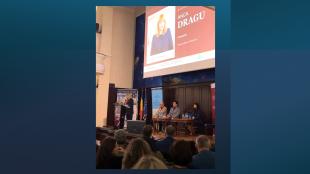
Bine ați venit pe pagină oficială a Băncii Naționale a Moldovei!



Bine ați venit pe pagină oficială a Băncii Naționale a Moldovei!
Cele mai populare rapoarte statistice:
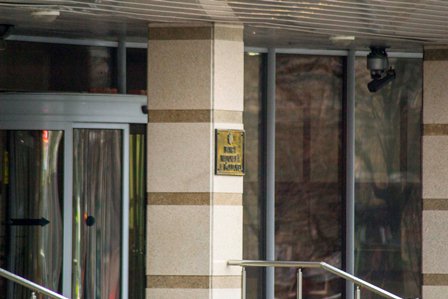
Banca Naţională şi membrii organelor de conducere ale acesteia sunt independenţi în exercitarea atribuţiilor stabilite de lege şi nu pot solicita şi nici accepta instrucţiuni de la autorităţile publice sau de la orice altă autoritate.



Banca Naţională informează publicul despre evoluția inflației anuale, strategia de politică monetară,rezultatele analizei macroeconomice, evoluţiei pieţei financiare şi informaţia statistică, inclusiv privind masa monetară, acordarea creditelor, balanţa de plăţi şi situaţia pieţei valutare.

Pentru asigurarea şi menţinerea stabilităţii preţurilor pe termen mediu, Banca Naţională a Moldovei menţine inflaţia (măsurată prin indicele preţurilor de consum) la nivelul de 5.0 la sută anual cu o posibilă abatere de ± 1.5 puncte procentuale, fiind considerat nivelul optim pentru creşterea şi dezvoltarea economică a Republicii Moldova pe termen mediu.




Stabilitatea financiară se realizează prin consolidarea rezilienței sistemului financiar, limitarea efectului de contagiune și diminuarea acumulării de riscuri sistemice, contribuind, astfel, la sustenabilitatea sectorului financiar și creșterea economică.




Banca Naţională a Moldovei, are dreptul exclusiv de a emite pe teritoriul Republicii Moldova bancnote şi monede metalice ca mijloc de plată. BNM pune în circulaţie bancnote şi monede metalice, prin intermediul sistemului bancar.




Banca Naţională este unica instituţie care efectuează licenţierea, supravegherea şi reglementarea activităţii instituţiilor financiare.


Banca Națională supraveghează sistemul de plăţi în Republica Moldova şi promovează funcţionarea stabilă şi eficientă a sistemului automatizat de plăţi interbancare.


Banca Naţională este o persoană juridică publică autonomă şi este responsabilă faţă de Parlament.

BNM publică statistici privind masa monetară, sectorul bancar, balanța de plăți, situația pieței valutare, etc. pentru a asigura transparența în procesul de elaborare și adoptare a deciziilor BNM, a asigura continuitatea în comunicare și predictibilitatea BNM pe piață, pentru sporirea credibilității BNM în calitate de bancă centrală dar și pe piața financiar-bancară din Republica Moldova.


The Executive Board of the National Bank of Moldova, at its meeting on 19 September 2023 adopted by unanimous vote the following decision:
This decision is adopted in view of the continuing propagation of the monetary policy easing measures of the last period and aims to anchor inflation expectations and ensure the necessary monetary conditions to bring inflation back to and maintain it close to the 5.0 percent medium-term inflation target.
The decision of the NBM is geared towards stimulating aggregate demand, including by encouraging consumption and balancing the national economy.
New macroeconomic information confirms the validity of the latest forecast as well as the anticipated disinflationary trend.
The prospect of economic support is conditional on the easing of consumer prices and their expected downward trend, together with the persistence of excess liquidity and further declines in interest rates.
At the next monetary policy meeting on 7 November, the National Bank of Moldova will examine the opportunity to further decrease the base rate. Its magnitude will depend on new information on the global economy, as well as on the domestic environment such as: the volume of state financial aid for the cold period of the current and next year, the dynamics of natural gas, electricity and heating tariffs, the dynamics of interest rates, as well as the evolution of the volume of loans granted. At the same time, the decisions on the rectification of the state budget for the year 2023 and the drawing of guidelines for the year 2024 will also have a significant impact on the conduct of monetary policy.
The National Bank of Moldova adjusts the conditions on the money, credit, and foreign exchange markets in advance. In this way, it assumes the configuration of monetary policy according to need and aims to keep inflation close to the 5.0 per cent target in the medium term, creating all the necessary preconditions for implementing a mix of macroeconomic policies associated with the economic growth.
In this context, the NBM reiterates the need for coordination and interaction of monetary and fiscal policy measures in order to maximise their effects on the real economy and inflation.
The National Bank of Moldova will continue to monitor the internal and external macroeconomic situation, the risks associated with the evolution of inflation and, depending on these, will manage monetary conditions in order to keep inflation close to the target in the medium term.
Inflation developments. The annual inflation decreased by 1.1 percentage points to 9.7 percent in August 2023, 0.2 percentage points higher than expected. The deviation of actual inflation from the forecast was mainly driven by fuel prices, as a result of higher-than-expected oil prices.
The increase in tariffs with their side effects, the war in Ukraine and the drought last summer keep inflation above target. The disinflationary demand starting in mid-2022 and the appreciation of the MDL since the beginning of this year continue to dampen these factors.
External environment. Although economic activity in the euro area and China is contracting, the US economy continues to grow and stimulate global demand. Commodity prices remain high, maintaining higher export revenues for emerging economies. Oil prices exceeded USD 90/barrel after Saudi Arabia and Russia extended oil production curbs. Global natural gas prices increased also due to the extension of the annual technical service at Norwegian extraction platforms. Food prices continued to decrease after it became clear that export reserves are sufficient and the risks of supply shortages - minor. However, inflation remains persistent in advanced economies, causing financial markets to adjust their behaviour accordingly.
Economic activity. Most indicators of economic activity continued the negative trend, confirming the expectation of contraction for the second quarter of 2023 when the inflation forecast was updated. Recent data published by the NBS reveals a 2.2 percent contraction in GDP compared to the same period of 2022, following a 2.4 percent decline earlier this year. This development in economic activity was underpinned by modest domestic demand conditioned by a 7.7 percent decline in household consumption and a 6.9 percent decline in gross fixed capital formation amid a reduction in real household income, still restrictive credit conditions, as well as increased uncertainty in the region. This impact was partly mitigated by the favourable outcome in the agricultural sector and the performance in the information and communication sectors.
Monetary conditions. Interest rates on new loans and deposits in local currency also declined in August following the cumulative monetary policy stimulus. The weighted average interest rate on deposits in MDL decreased by 0.57 percentage points from the previous month to 4.52 percent. At the same time, the rate on loans granted amounted to 11.33 percent, 0.40 percentage points lower than in July 2023. Interest rates on foreign currency loans and deposits showed different trends - on loans they continued to increase, while on deposits they decreased.
Forecast update. The balance of risks to the inflation forecast remains disinflationary, and uncertainties remain pronounced. The main sources are the tense situation in the region, the reflection in the statistics of compensation for utilities, demand, and price volatility on the international market. In advanced economies, interest rates are expected to increase further and remain high for longer.
In identifying and assessing the risks of deviation in the inflation forecast, a more pro-inflationary character of fuel prices up to the third quarter of 2024, as well as of regulated and food prices during the first four quarters of the forecast is highlighted, given a lower core inflation in the first two quarters of the forecast.
The next meeting of the Executive Board of the NBM on monetary policy promotion will take place on 7 November 2023, according to the approved schedule.


